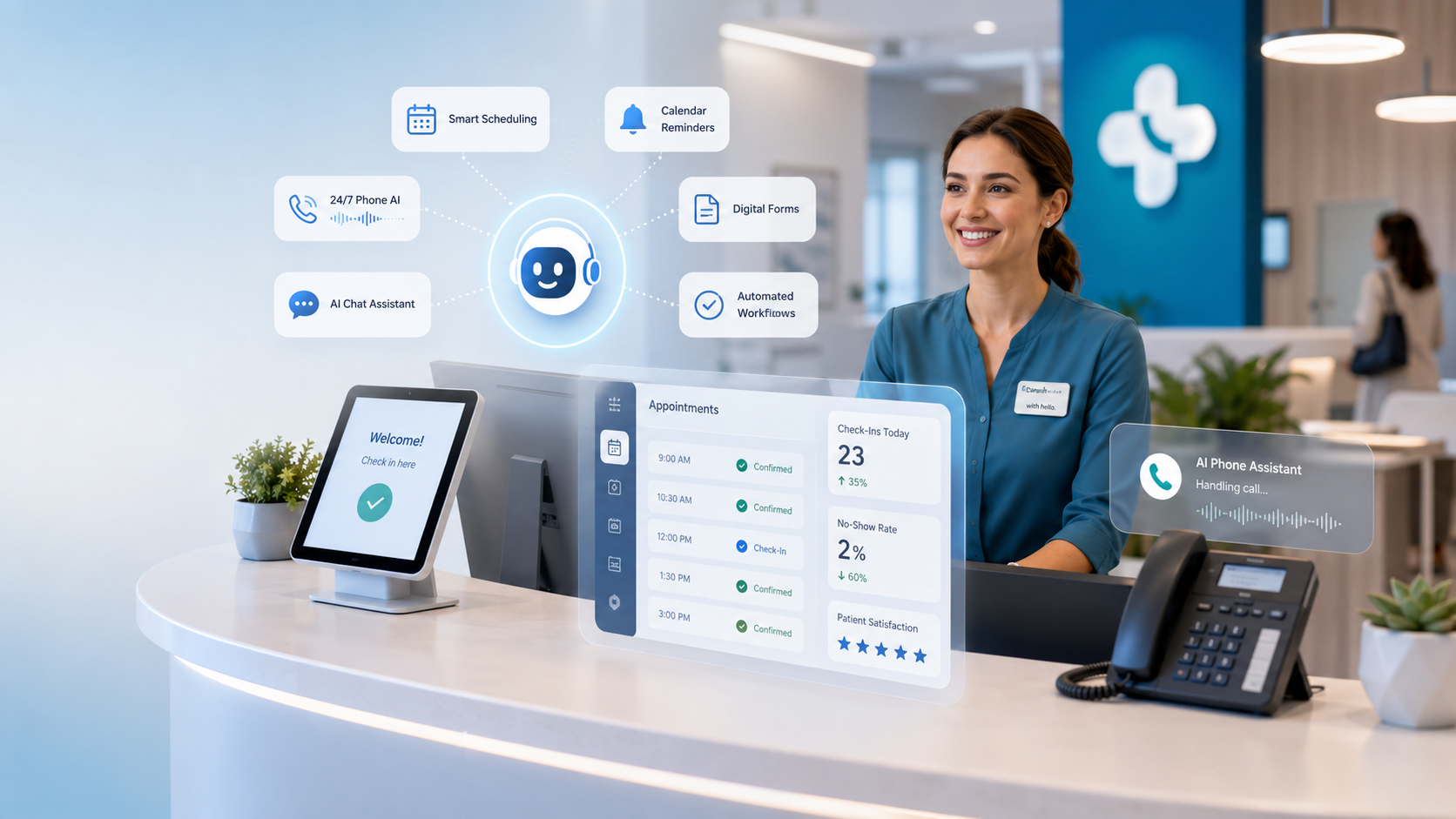
The front desk of a medical practice is where patient relationships begin and, too often, where they break down. Phones ring unanswered during peak morning hours. Hold times stretch past the point of patience. Staff spend the majority of their day on scheduling, insurance verification, and callbacks that never required a human in the first place.
For health and wellness practices operating on tight margins with lean teams, the cost of an inefficient front desk compounds quickly: lost appointments, frustrated patients, and burned-out staff who leave for less demanding roles in other industries. The benefits of virtual medical receptionists address each of these pain points directly.
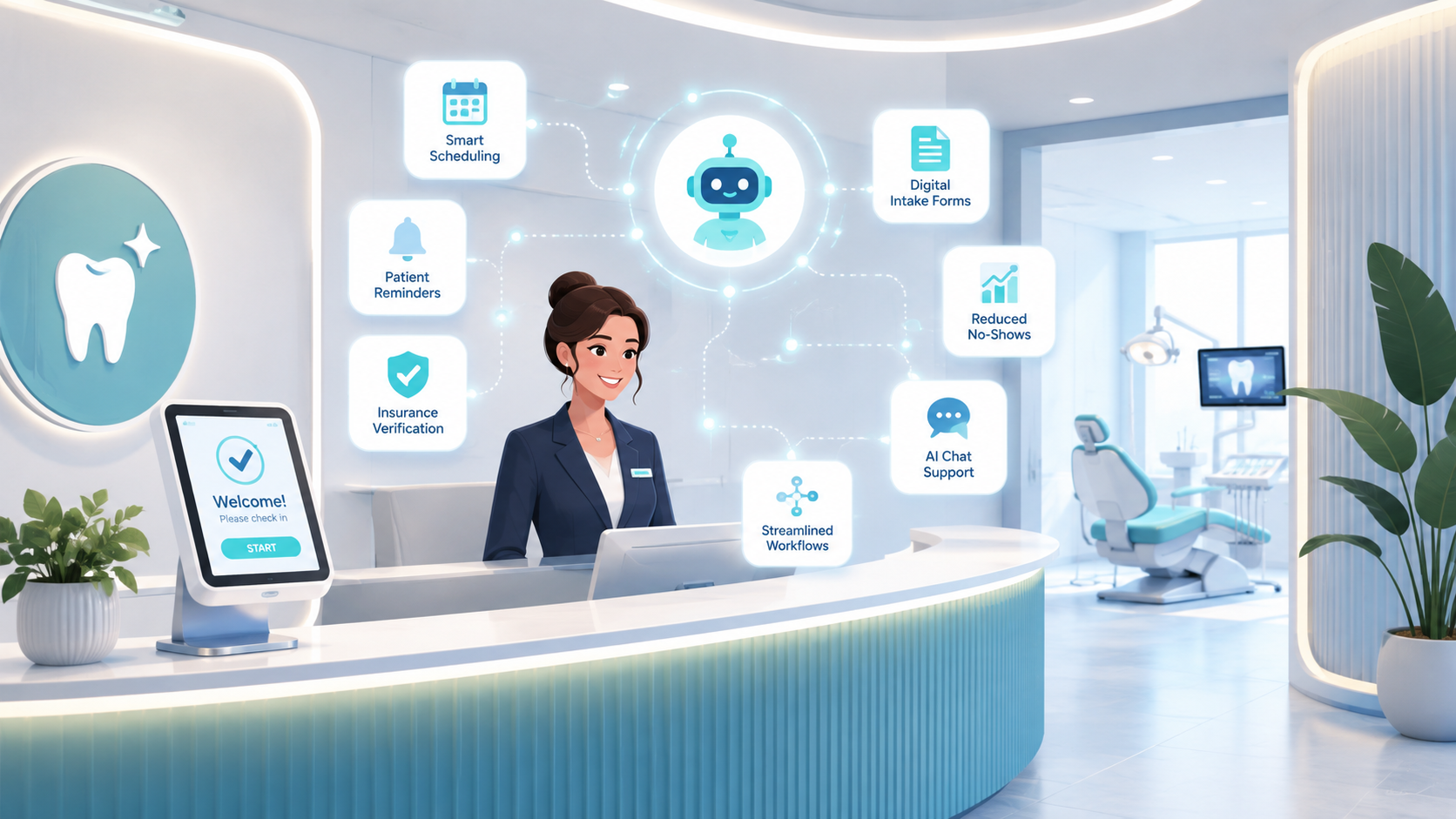
An AI front desk assistant healthcare solution changes this dynamic entirely. Rather than replacing staff, it absorbs the repetitive, high-volume work that keeps them from doing what they were hired to do: care for patients.
This article covers the key benefits of virtual receptionist for clinics and medical practices, from reduced no-shows to real-time patient intelligence. Whether the goal is cost reduction or revenue growth, an AI front desk assistant healthcare platform delivers on both.
What Is an AI Front Desk Assistant?
A digital receptionist in healthcare is an AI-powered agent that manages patient-facing communication across multiple channels: web chat, SMS, phone, WhatsApp, and social media. It handles scheduling, insurance inquiries, prescription refill requests, and general questions without requiring a human to intervene.
The distinction between a traditional chatbot and an AI receptionist for medical office operations matters. A chatbot follows a rigid script. An AI concierge reads the context of the conversation, remembers returning patients, and adapts its responses based on what each person actually needs. Think of the difference between an automated phone tree and a knowledgeable office manager who already knows the patient’s name when they walk in.
For health and wellness businesses managing high patient volumes across multiple touchpoints, the operational impact is significant. Below are 10 benefits of hiring virtual receptionists that make the case for automation clear.
10 Benefits of Automating Your Medical Front Desk
-
Round-the-Clock Patient Access
Patients do not limit their health concerns to business hours. One of the most immediate benefits of virtual receptionist for clinics is round-the-clock availability. An AI-powered system fields appointment requests, answers after-hours questions, and triages inquiries at 2 a.m. with the same accuracy as 2 p.m.
According to Tebra’s 2025 Patient Perspectives Report, 47% of patients have left a practice due to poor experience, while 70% will walk away if communication falls short of expectations. An AI receptionist ensures that no message goes unanswered, regardless of the hour or channel it arrives through.
For wellness clinics and integrative health practices that serve clients across time zones, this kind of always-on availability is especially critical. A prospective patient researching acupuncture options at 10 p.m. should receive the same quality of response as one calling during business hours.
-
Reduced Patient No-Shows
Missed appointments cost the U.S. healthcare system an estimated $150 billion annually, with each unfilled slot averaging $200 in lost revenue. An AI front desk assistant healthcare platform reduces no-shows by sending automated reminders through SMS, email, and WhatsApp, then allowing patients to confirm, cancel, or reschedule in seconds.
This is not a one-way notification. The AI processes each response and updates the schedule in real time, freeing the slot for another patient the moment a cancellation occurs.
-
Lower Administrative Overhead
An American Medical Association study found that physicians spend nearly 49% of their office day on desk work and data entry rather than patient care. For front desk staff, the picture is similar: research suggests that 30 to 50% of their time is consumed by inbound calls, voicemails, and appointment coordination alone.
An AI receptionist for medical practice operations absorbs this workload. The benefits of hiring virtual receptionists become most apparent here: practices that automate front desk functions can redirect staff toward higher-value interactions rather than routine phone calls. Some organizations using AI concierge platforms have reduced support volume by up to 80%, a figure that translates directly into lower staffing costs and fewer burnout-driven resignations.
-
Faster Patient Response Times
In healthcare, response speed affects both patient outcomes and satisfaction. A digital receptionist in healthcare responds instantly to every inquiry, whether it arrives by web chat, text message, or voice call.
The alternative is a patient on hold for four minutes or more, navigating a phone tree, then leaving a voicemail that may not be returned until the next business day. Consider this the way an emergency room considers triage: the faster a concern is acknowledged, the less likely it is to escalate. AI eliminates that friction point entirely, compressing response times from hours to seconds and ensuring that every inquiry receives immediate attention.
-
Multilingual Patient Communication
Medical practices in diverse communities often struggle to serve non-English-speaking patients effectively. Hiring multilingual staff is expensive and logistically difficult, particularly for smaller clinics.
An AI concierge communicates in dozens of languages simultaneously, drawing from one shared knowledge base. No separate bots. No third-party translation services. One platform, every language a patient might speak. For health and wellness businesses serving multilingual populations, this is one of the most underrated benefits of virtual medical receptionists: the ability to remove a language barrier that has historically required significant overhead to address.
-
Consistent, Error-Free Information
Human receptionists, regardless of skill level, deliver slightly different answers depending on the day, their training, or how busy the office is. A virtual medical receptionist delivers the same verified information every time: correct hours, current insurance acceptance lists, and precise pre-visit instructions.
This consistency reduces patient confusion and eliminates the downstream support calls that result from miscommunication. Among the benefits of virtual medical receptionists, accuracy is one that compounds over time. When every patient receives the same correct answer, fewer issues escalate to clinical staff. For practices with multiple providers or locations, the value multiplies: the AI draws from a single, centralized knowledge base, so answers remain consistent regardless of which office or channel the patient contacts.
-
Omni-Channel Patient Engagement
Patients today communicate through a range of channels. Some prefer texting. Others call. Many use WhatsApp or send messages through Instagram or Facebook. Managing these channels separately creates fragmented records and duplicated effort.
A well-designed AI concierge connects all channels under a single system with shared context and memory. A patient who begins a conversation on the clinic website and follows up via SMS does not have to repeat their question. The AI retains the full history of every interaction, across every channel.
-
Actionable Patient Insights
Most front desk interactions generate useful data that never gets captured. A digital receptionist in healthcare changes this by logging, categorizing, and analyzing every conversation automatically.
Advanced platforms include built-in sentiment analysis that identifies patterns in patient concerns, flags recurring friction points, and delivers weekly reports to practice leadership. Rather than guessing why patients are dissatisfied, clinic operators receive specific, data-backed answers they can act on immediately. For any virtual receptionist for medical practices, this kind of intelligence layer transforms a cost center into a strategic asset. One practice leadership team described this as receiving a “CEO-ready” strategy summary each week.
-
Increased Appointment Bookings and Revenue
An AI receptionist does more than answer questions. It actively guides patients toward the next step, whether that means booking an appointment, completing intake forms, or scheduling a follow-up visit.
This conversion-oriented approach delivers measurable financial impact. Businesses using AI concierge platforms have reported adding approximately $20,000 in revenue within three months, with 94% of support inquiries resolved without human intervention. For practices aiming to grow without proportionally increasing headcount, the return on investment speaks for itself.
The analogy is straightforward. A skilled office manager does not just answer the phone; they recognize what the caller needs and guide them toward the right service. An AI concierge operates the same way, at scale, across every channel simultaneously.
-
Scalability Without Proportional Cost Increases
Scaling a traditional front desk means hiring more staff, expanding phone systems, and increasing training budgets. Scaling an AI front desk assistant means adjusting a subscription tier.
Whether a practice handles 50 patient interactions per week or 5,000, the AI manages the volume without performance degradation. Platforms with transparent, flat-rate pricing make cost forecasting straightforward, with no per-seat fees or hidden charges as the practice grows. Of all the benefits of virtual receptionist for clinics, scalability is the one that separates short-term savings from long-term transformation.
Frequently Asked Questions
Is an AI receptionist HIPAA-compliant?
Reputable AI platforms are built with data security and patient privacy as foundational requirements. That said, compliance is not a feature to assume. Before selecting a virtual receptionist for medical practices, verify that the provider offers encrypted data transmission, role-based access controls, and clear data retention policies. Request documentation and, where possible, third-party audit certifications.
Will an AI front desk assistant replace my existing staff?
No. An AI receptionist for medical office environments is designed to handle the repetitive, high-volume tasks that consume the most staff time: scheduling, FAQs, appointment reminders, and after-hours inquiries. This frees front desk employees to focus on in-person patient interactions, complex insurance cases, and other work that benefits from a human touch. The goal is augmentation, not replacement.
How long does it take to set up an AI receptionist for a medical practice?
Most modern platforms can be configured in minutes, not months. The AI is typically trained on a practice’s existing website content, knowledge base, and FAQs, so there is no need to build responses from scratch. Practices that want a hands-off experience can opt for managed setup services that handle configuration, testing, and optimization entirely.
Can an AI concierge handle appointment scheduling and cancellations?
Yes. A well-built AI front desk assistant healthcare solution integrates with existing scheduling and practice management tools to book, confirm, reschedule, and cancel appointments in real time. Patients can interact through whichever channel they prefer, including web chat, SMS, WhatsApp, or voice, and the system updates the calendar instantly without staff intervention.
Getting Started with AI Front Desk Automation
Implementing an AI receptionist for medical practice operations does not require a technical background or a months-long deployment. Modern platforms are built for non-technical operators and can be configured in minutes.
For health and wellness businesses evaluating this shift, the recommended starting point is a live demo that shows how the AI handles real patient scenarios specific to the practice’s specialty. Practices that prefer a fully managed approach can explore done-for-you setup services that include configuration, knowledge base training, and a performance guarantee: 30% more conversions or 80% less support load within 30 days.