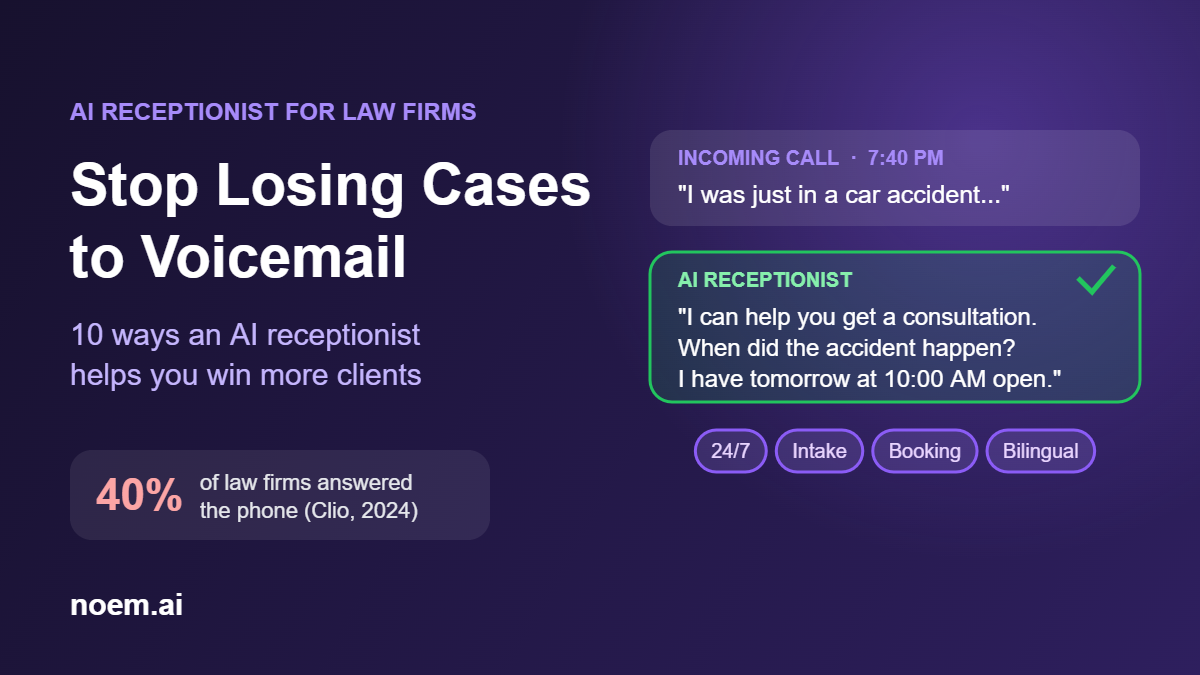
A potential client calls your firm at 7:40 p.m. after a car accident. Nobody picks up. They call the next firm on the list, someone answers, and that firm books the consultation. For most practices, the cases you lose are not the ones you argue badly. They are the ones that never reach you. An AI receptionist for law firms answers every call, chat and text, qualifies the inquiry and books the consultation, so no new matter slips away while your team is in court, in a meeting or asleep.
This guide covers what the data says about law firm responsiveness, 10 ways an AI receptionist helps you sign more clients, and the ethical guardrails to set up before you turn one on.
Key takeaways
- Most law firms are hard to reach: in a 2024 secret shopper study, only 40% answered the phone and 33% replied to emails.
- An AI receptionist covers calls, web chat, SMS and WhatsApp 24/7, so first contact never waits for business hours.
- It should qualify, schedule and route, never give legal advice.
- Clients are open to it if a human is always one step away, and your ethics duties on confidentiality and supervision still apply.
The first-impression problem law firms can’t afford
For the 2024 Clio Legal Trends Report, a research firm posed as a potential client and contacted 500 US law firms. The results, summarized by 2Civility, are hard to ignore:
| What the secret shopper tested | 2019 | 2024 |
|---|---|---|
| Firms that answered the phone | 56% | 40% |
| Firms that replied to emails | 40% | 33% |
Nearly half of the firms (48%) neither answered nor called back, which made them essentially unreachable by phone. Only 12% of the secret shoppers said they would recommend the firm they contacted. Meanwhile, people who reached a live person on the phone were far more likely to recommend the firm than those who only got voicemail.
The takeaway: responsiveness is the first thing a potential client judges you on, long before they see your results.
10 ways an AI receptionist helps law firms win more clients
1. Answers every call, chat and text, 24/7
Accidents, arrests and family emergencies don’t follow office hours. An AI receptionist picks up nights, weekends and holidays, and it never puts a caller on hold because the front desk is busy with someone else.
2. Responds to web inquiries in seconds
A contact form that gets answered the next morning is often too late. AI chat on your website replies immediately, keeps the visitor engaged and moves them toward a consultation while they are still on your page.
3. Qualifies leads by practice area
The receptionist asks the screening questions you define: type of matter, date of the incident, location, whether they already have an attorney. Your team only spends time on inquiries that fit your practice, and out-of-scope callers get a polite referral instead of a voicemail.
4. Captures complete intake details
Instead of a half-finished message slip, you get a structured summary: name, contact details, matter type, key facts and urgency. Your intake team starts the follow-up with everything in front of them.
5. Books consultations on your calendar
Once a lead qualifies, the AI receptionist offers open slots and books the consultation directly, with confirmations and reminders. Fewer back-and-forth emails means fewer prospects who go cold before the first meeting.
6. Escalates urgent matters to a person
Some calls can’t wait: someone was just arrested, a hearing is tomorrow, a deadline is about to pass. Set clear triggers so those conversations go straight to an attorney or on-call staff member, with the full transcript attached.
7. Speaks your clients’ language
Many firms serve communities where English is not the first language. A multilingual AI receptionist can greet, screen and schedule in Spanish or other languages, so you don’t lose a case because nobody on shift could understand the caller. Learn more in how to scale multilingual support without ballooning costs.
8. Answers routine questions consistently
Office hours, location, parking, what to bring to a consultation, whether you offer free consultations or work on contingency: the AI gives the same accurate answer every time, based on information you approve. Your staff stops repeating the same answers all day.
9. Gives existing clients faster updates
Many calls to a law firm are from current clients asking about next steps or how to send a document. An AI receptionist can handle general process questions and route case-specific ones to the right person, which keeps clients informed and reduces interruptions for attorneys and paralegals.
10. Shows you where cases are won and lost
Every conversation is logged, so you can see how many inquiries came in after hours, which practice areas are growing and where prospects drop off. That turns intake from a black box into something you can measure and improve.
Ethical guardrails before you turn it on
An AI receptionist is a client-facing tool, so your professional duties still apply. ABA Formal Opinion 512, issued July 29, 2024, gives a useful framework for generative AI in legal practice (American Bar Association). For intake, the practical checklist looks like this:
- No legal advice. The receptionist screens, schedules and shares general firm information. It should say clearly that it is not a lawyer and that no attorney-client relationship is formed until the firm confirms it.
- Confidentiality. Know where conversations and recordings are stored, who can access them and whether they are used to train models. Put data ownership and deletion terms in your contract. Our guide to privacy-first chat scripts shows how to collect only what you need.
- Supervision. Treat the AI like any nonlawyer assistant: set firm policies for what it can and can’t say, and review transcripts regularly.
- Accuracy. Ground every answer in content your firm approves, and test it with tricky questions before launch. See why AI gives wrong answers and how to prevent it.
- Human handoff. In the same Clio research, three out of five potential clients said they would only use a chatbot if they could switch to a human when needed. Make that option obvious.
Rules vary by state and country, so check with your bar’s ethics guidance. This article is general information, not legal advice.
How to choose an AI receptionist for your law firm
| Feature | Why it matters for a law firm |
|---|---|
| Phone, web chat, SMS and WhatsApp | Prospects reach out wherever they are; every channel should get the same fast answer |
| Custom intake questions | Each practice area needs different screening criteria |
| Calendar booking | Turns a qualified lead into a scheduled consultation immediately |
| Urgent escalation rules | Time-sensitive matters reach a person right away |
| Multilingual support | Serve clients in their preferred language |
| Data ownership and privacy terms | Protects client confidentiality and your ethical obligations |
| CRM integration and transcripts | Intake data flows into your systems with a full record |
Comparing vendors? Start with our roundup of the 10 best AI receptionist software platforms for 2026, and see how intake automation works in practice in transforming client intake with an AI concierge.
Frequently asked questions
Can an AI receptionist give legal advice?
It shouldn’t. A well-configured AI receptionist answers general questions about your firm, collects intake details and books consultations. Questions about a specific legal situation should be routed to an attorney.
Is an AI receptionist safe for confidential client information?
It can be, if you choose a provider with clear data ownership, access controls and deletion policies, and you limit intake to the information you actually need. Review the provider’s terms with your firm’s confidentiality obligations in mind.
Will potential clients be comfortable talking to AI?
Many are, especially for a first contact. In Clio’s 2024 research, 51% of prospective clients agreed chatbots can be a helpful starting point for exploring legal options, as long as a human is available when they need one.
Does an AI receptionist replace my front desk staff?
It supports them. The AI handles after-hours coverage, routine questions and first-pass screening, so your staff can focus on qualified prospects, existing clients and work that needs human judgment.
How long does it take to set up?
Most firms can launch a basic setup quickly: add your practice areas, intake questions, approved answers and calendar, test it, then expand to phone and other channels.
Stop losing cases to voicemail
Noem.ai gives law firms an AI receptionist that answers calls, chats and texts around the clock, screens new matters with your intake questions, books consultations and hands urgent cases to your team. See how Noem.ai works for law firms.