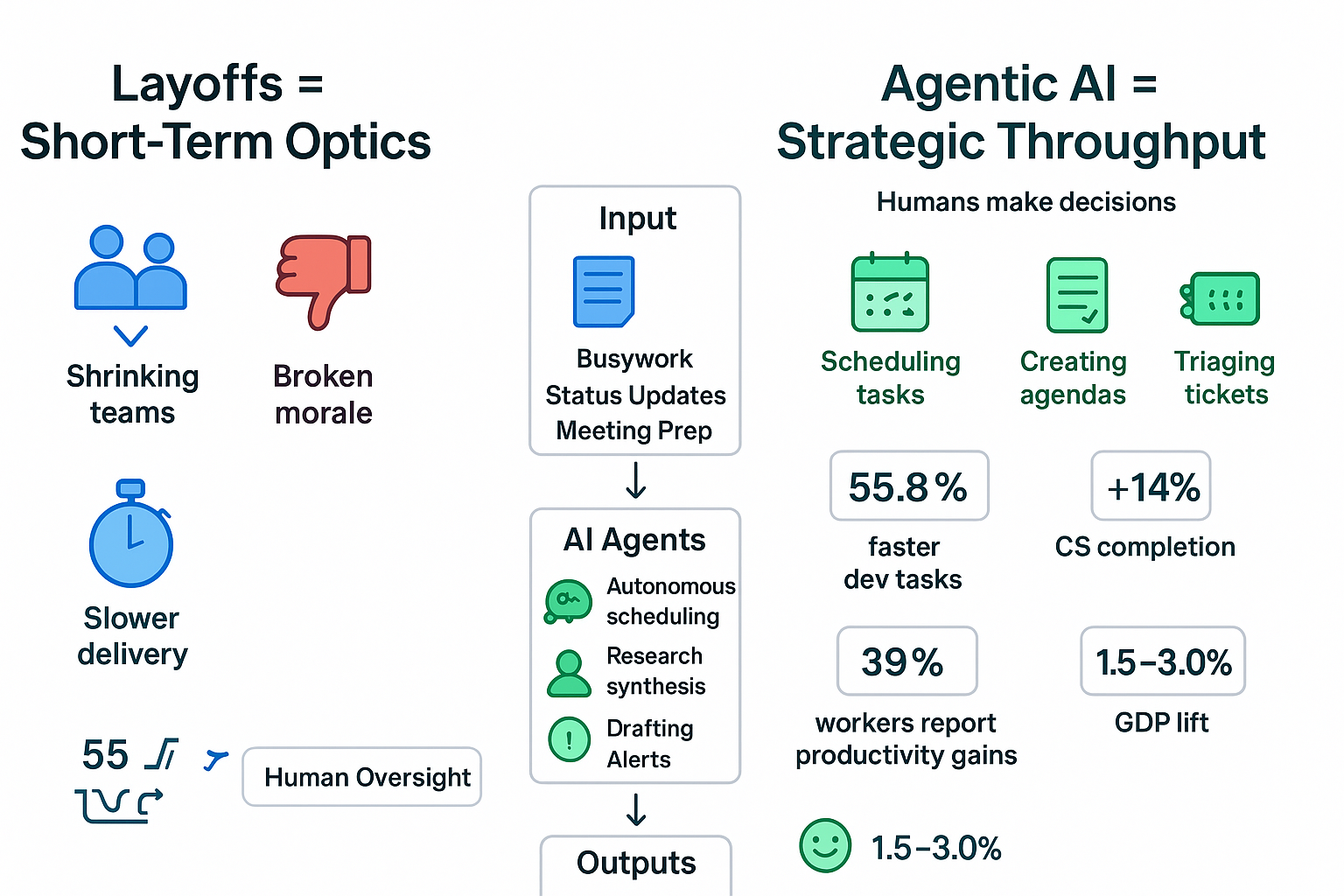
Layoffs Are Not Productivity — Use AI to Amplify Strategic Thought, Not Replace People.

11 Feb 2026 by Daniel Hindi

  • 12 min
  • 111 Views

Cut busywork, not headcount. Aim AI at bottlenecks, and watch strategy speed up.

The CEO Math: Productivity Is About Better Output, Not Fewer People

Layoffs can make a spreadsheet look cleaner for one quarter, but they rarely make products better, customers happier, or teams faster over the long haul. Real productivity is “more value out the door with the people you have,” not “fewer people doing the same work and burning out.” Today’s data says AI can help your team do higher-value work, faster, if you point it at the right problems. Nearly 39% of employees say AI tools made them more productive over the last year, which means the upside is real and present, not just hype (ref: DHR Global). But some companies are still cutting headcount based on AI’s potential, not its actual performance, which is a strategy that trades long-term capability for short-term optics (ref: Harvard Business Review).

Use AI to remove the drag on your smartest people, so they can think, decide, and ship. Focus on waste—rework, status writing, task juggling, and context switching—not on people. When we replace repetitive steps with autonomous agents, the payoff is compounding: cycles speed up, quality improves, and customers feel the difference. With platforms like NOEM.ai, you can deploy pre-trained, specialized SDR and CS AI Chatbot Agents that take on lead qualification and customer support triage, so your team can spend more time on closing strategy and customer outcomes.


Where AI Delivers Real, Bankable Gains (And Why That Changes Your Hiring Story)

The strongest results show up when AI augments people at the task level, not when it replaces a role outright. For example, developers working with assistive coding tools can finish coding tasks 55.8% faster, which means more features per quarter without adding headcount—and without burning out your current team (ref: Alex Imas). Customer service teams using a generative AI assistant complete tasks 14% more often, which is the kind of improvement that customers feel in resolution time and satisfaction (ref: Penn Wharton Budget Model). These are not small wins; they are force multipliers that stack across your operations.

Here’s the deeper insight: the biggest benefits often flow to your less experienced or lower-performing workers, who see outsized lifts when they have AI at their side. Studies show output quality can jump—measured at 0.4 standard deviations higher—and the uplift is largest among those who need it most (ref: Alex Imas). If you cut those people before you add AI, you’re removing the very population that gets the largest performance boost. Keep them, equip them, and you compress the performance gap inside the team, making your whole organization more resilient and predictable.

Over the long term, macro models project that AI can lift productivity and GDP by roughly 1.5% by 2035 and close to 3% by 2055, which is a slow, steady, compounding tailwind—not an overnight replacement wave (ref: Penn Wharton Budget Model). Translation for the CEO: this is a multi-year operating advantage you can invest behind, not a one-time “cut and hope” event. With NOEM.ai, those gains become concrete when specialized agents autonomously manage the high-volume outreach and support inquiries that eat sales and success time. Give the team better tools, and your roadmap gets faster without shrinking the people who make it real.


  • Aim AI at bottlenecks first: The best ROI shows up when we remove blockers that slow handoffs and decisions. In sales and support, this means automating the “first touch.” Use AI to handle initial queries and lead qualification so reps only jump in when a lead is warm. Platforms like NOEM.ai shine here because their specialized agents keep the pipeline moving while humans focus on the high-value interactions.

  • Lift the floor, then raise the ceiling: When entry-level and mid-tier team members get AI aids, their work becomes consistent and faster. That steadiness frees senior folks to do deeper strategy and complex judgment calls. Over time, you get better throughput and fewer fire drills. This is why keeping your people and augmenting them beats cutting headcount and hoping the remaining team can carry the load (ref: Alex Imas).

  • Invest the savings back into capability: Labor cost savings from AI today average around 25%, and may rise toward 40% in the coming decades, but you don’t need layoffs to get those savings (ref: Penn Wharton Budget Model). Use those dollars to upskill your team on AI tools, create new oversight roles, and fund pilot projects where agents manage the administrative load. With NOEM.ai, you can deploy pre-trained agents specifically designed for SDR and CS workflows that skip the months of generic tuning.

  • Build clarity as you build capability: Productivity is rising faster than clarity in many firms, and that’s a risk (ref: DHR Global). When people don’t know how AI changes their work, they assume the worst and disengage. Leaders must narrate the plan: where AI helps, where humans lead, and how careers grow. Clear paths plus visible wins create trust, which speeds adoption without fear.


The Hidden Costs Of Cutting Too Soon (And How To Avoid Them)

There’s a perception gap inside many teams: once AI handles the easy tasks, people spend more time on strategic, messy, creative work. That work is harder to measure, so even while output value rises, some employees feel less productive because there are fewer quick wins to point to (ref: Cognizant). If you then cut staff, you amplify the mismatch between effort and recognition. Morale drops, turnover rises, and knowledge walks out the door. These are costs you never see on the layoff announcement but pay for across every quarter after.

Skill compression is the other hidden cost. Lower-performing workers benefit most from AI support, which means augmentation narrows the gap between top and middle performance (ref: Alex Imas). Remove those people and your remaining team loses bench strength and resilience under load. The result: long release cycles, uneven service, and more quality escapes. Keep the team, add AI, and you get smoother execution and stronger quality control without the fear tax.

Finally, there’s the story you tell the market. Cutting because “AI will replace roles soon” signals that leadership is betting on potential, not performance, which is the opposite of disciplined execution (ref: Harvard Business Review). Customers want partners who invest in capability, not just cost control. When you deploy agents like those in NOEM.ai to automate top-of-funnel sales and routine support, you show clients that you are building a smarter operation with a human core. That message earns trust and, over time, more revenue.


  • Recognize strategic work on purpose: When AI clears routine tasks, people do harder, more valuable work—strategy, judgment, and relationship building. These outputs don’t fit neatly into old dashboards. Update your scorecards to include decision cycle time, risk avoided, and customer outcomes. Recognition must evolve alongside the work or you risk demotivating the very people creating new value (ref: Cognizant).

  • Communicate “augment, don’t replace” early and often: Teams need a clear picture of how AI supports them today and what new opportunities it opens tomorrow. Share your blueprint, the pilots you’re running, and the roles you’re creating. Clarity drives engagement and speeds adoption. Absent clarity, rumor fills the gap and slows everything (ref: DHR Global).

  • Create new oversight and orchestration roles: As agents handle more routine work, you need people who set guardrails, review outputs, and connect customer context to AI workflows. These are high-leverage roles that magnify the value of every agent you deploy. It’s not headcount bloat; it’s multiplying the impact of your existing team. Use NOEM.ai to deploy agents that can manage entire customer conversations, only escalating to these oversight roles when a human touch is required.

  • Let attrition, not layoffs, rebalance the org: Natural churn gives you a path to reshape roles without breaking culture. As AI takes on more administrative load, re-scope open reqs toward strategic, customer-facing work. Invest in upskilling so current staff can step into those roles. This keeps institutional knowledge in-house while your operating model evolves (ref: DHR Global).


Agentic AI: Keep Your Managers, Cut The Admin—This Is Where The Real Leverage Lives

Agentic AI can now orchestrate tasks that used to soak up manager time: project triage, resource allocation, meeting prep, research consolidation, and follow-up tracking. The point is not to delete managers; it’s to free them to do the parts only humans can do: priorities, tradeoffs, coaching, and hard calls under uncertainty (ref: World Economic Forum). Think of agents as a no-drama chief of staff for every team lead. They collect signals, propose a plan, and keep the wheel turning while your leaders steer.

This is where NOEM.ai is built to excel. Unlike generic agentic tools, its agents are specialized for the Sales and Success stack. They don’t just “chat”; they autonomously qualify leads, handle support tickets, and manage interactions across the customer lifecycle without constant human nudges. Pre-trained agents bring domain knowledge on day one, so you get value without long onboarding cycles. Even better, these agents are designed for performance—ensuring that your SDR and CS workflows run at peak efficiency while your managers focus on high-level strategy.


  • Orchestrate, don’t micromanage: Let agents handle the how—qualification checklists, support triage, and follow-up timing—while managers handle the why and what. This shifts time from status to strategy. It also reduces errors caused by context switching. The end result is faster cycles and fewer drop balls (ref: World Economic Forum).

  • Pre-trained beats build-from-scratch: If you spend six months training a generic model to understand a sales process, your ROI clock is ticking without returns. Pre-trained, specialized agents give you day-one impact. The specialized SDR and CS agent library in NOEM.ai is designed for exactly this kind of fast start in revenue-generating roles.

  • Autonomy with guardrails: Autonomy is only useful if it’s safe and reviewable. Keep humans in the loop for high-value closures and complex escalations while agents run the routine inquiries. Add audit trails so you can see decisions and outcomes. This builds trust and accelerates adoption without adding risk (ref: Cognizant).

  • Specialized AI compounds value: When agents are purpose-built for a function, you get a mini-workforce that understands the nuances of a customer journey. This isn’t a generic chatbot; it’s a frontline operations layer. This is the heart of NOEM.ai—moving beyond general assistance into real, trackable work in Sales and Support.


A Simple Playbook: Turn AI Into Strategic Throughput, Not Headcount Cuts

The companies that win with AI are not the ones that cut first; they’re the ones that design work around human judgment and AI endurance. They define what “good” looks like, measure the right outcomes, then let agents clear the path so people can sprint.

Here’s the five-step playbook I recommend:

  1. Map the work, not the org chart: Inventory tasks across your sales and support value chain—lead research, initial outreach, support triage, and routine check-ins. Tag tasks by repeatability and time spent. These are perfect for NOEM.ai agents to own with human oversight (ref: Cognizant).

  2. Pilot with a visible, painful bottleneck: Pick a process everyone hates—like lead response time or support ticket backlogs. Stand up NOEM.ai SDR or CS agents to handle the initial volume, qualify the need, and route the results. Measure conversion rates and resolution times for four weeks.

  3. Keep humans in the loop at decision points: Use agents to do the grunt work—gathering lead data or troubleshooting steps—but keep human approvals for contract terms or emotional customer escalations. This builds confidence and reduces risk.

  4. Update your dashboards for strategic work: Add metrics that capture front-office health—lead-to-close velocity, customer NRR (Net Revenue Retention), and first-response time. These are the outcomes AI should improve. Better dashboards prevent bad layoffs.

  5. Reinvest savings into skills and scale: As efficiency rises, put a fixed percentage back into training and deeper AI integration. Over time, you’ll reduce variance and build a culture that treats AI as a teammate. That is a flywheel worth funding for years (ref: Penn Wharton Budget Model).

Remember, layoffs create a tax on trust. The companies that keep their people and augment them with specialized agents don’t just move faster; they recruit easier and retain better. If you want a head start, the pre-trained, SDR and CS-ready agents inside NOEM.ai give you the speed to prove value this quarter and the flexibility to scale next quarter.


What To Tell Your Board (And Your Team) Right Now

Boards will ask, “Where are the savings?” The accurate answer is: in hours returned to strategy, in faster lead conversion, in higher customer satisfaction, and in scaled support without scaled costs. AI is not a headcount lever; it is a throughput lever. When your leaders get back the hours they spent on coordination and reporting, they ship more value, more often (ref: Penn Wharton Budget Model).

Your team wants to know if AI will erase their jobs. Tell them this: we are using AI to remove the repetitive “first-tier” work so you can do the parts only humans can do—closing deals and solving complex human problems. We will train you on these agents and expand your impact, not shrink your future (ref: DHR Global).

If you need a platform that delivers on this promise for your revenue and support teams, look at NOEM.ai. It moves beyond generic AI into specialized SDR and CS agents that drive real, trackable work. That is how you turn AI into a system of record—one that respects people, amplifies strategy, and compounds returns over time.

Focus on Decisions, We’ll Handle the Rest

While you make strategic decisions, Let Agent Noems efficiently run your company’s departments:

  • AI Support Chatbots
  • Lead Conversion Chatbots
  • Coaching Chatbots
  • Onboarding Chatbots
  • Virtual Clone Chatbots
Try It for Free

Where should we send your invitation to?