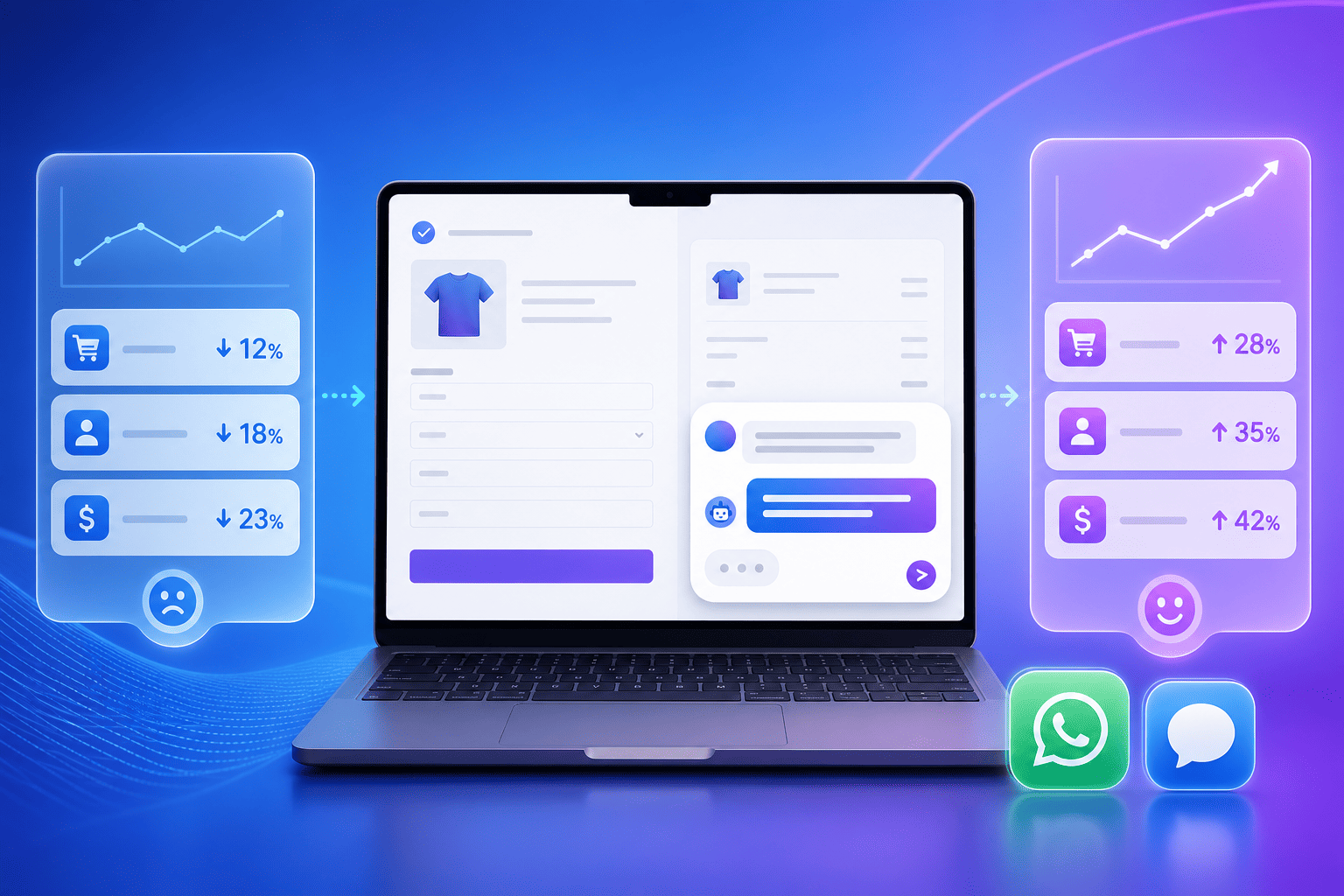
By replacing slow, static support with Noem.ai conversational flows, Trailblaze Outfitters cut checkout friction, answered after-hours questions, and lifted checkout conversions 28 percent. Fast replies matter because responding within 1 minute can improve conversion by 391 percent, which makes real-time chat a direct revenue lever (ref: Noem.ai ).
Key Points
- 28 percent checkout conversion lift after switching to conversational flows
- 24-7 support on site, WhatsApp, and SMS
- Faster replies reduced drop-offs at checkout
- Multilingual support captured international buyers
- Guided product picks replaced guesswork at the cart
- Recovery prompts saved stalled sessions
- AI chat tied to Shopify checkout and discounts
- Fast replies win shoppers (ref: Noem.ai )
Background: A Strong Brand With A Silent Checkout Problem
(ref: Digital Commerce 360 )
Trailblaze Outfitters is a mid-sized DTC brand that sells weekend-ready outdoor gear on Shopify. The product line, ads, and landing pages were solid, and traffic was growing. Yet checkout numbers lagged and revenue per visit stayed flatter than leadership expected. Research now shows AI-assisted traffic converts 42 percent more and drives 37 percent higher revenue per visit, so the team suspected their buyer support layer was the missing piece they had ignored for too long (ref: Digital Commerce 360 ). The idea was simple. They did not need a new product drop. They needed a new conversation.
The Challenge: Friction At The Exact Moment Of Intent
(ref: Triple Whale )
Buyers bailed during checkout for the same boring but costly reasons. They had questions about shipping cutoffs, returns, sizing, and bundle discounts, but help was too slow. Support hours ended at 6 p.m., yet nearly a third of carts were built after work or on weekends. Replies often took hours, not minutes, which killed momentum. Industry data shows AI chat can deliver about 4 times higher conversion, with 12.3 percent of AI-engaged shoppers buying versus 3.1 percent without chat, so the team knew speed and presence could make or break deals at the finish line (ref: Triple Whale ).
Approach: Switch To Noem.ai Conversational Flows Where It Matters Most
(ref: Noem.ai )
- Instant 24-7 checkout help: The team deployed Noem.ai flows that live on the site and inside checkout. The bot answered shipping, returns, sizing, and warranty questions in under a second. When a shopper typed a concern, the bot replied right inside the cart, not by sending them to a help center. Fast answers kept the buyer in flow and reduced pogo-sticking between pages. That constant presence mattered after hours when human reps were offline (ref: Noem.ai ).
- Guided product picks and bundles: Trailblaze used conversational prompts that asked 2 or 3 questions, then suggested the right size, variant, or add-on. This turned a stuck buyer into a guided buyer without adding friction. Research shows personalized experiences can lift conversion up to 15 percent, so even small adjustments at the cart can compound into real gains (ref: Ever-help ). The flow also handled edge cases like fit for layered clothing and seasonality.
- Recovery nudges for stalled sessions: Noem.ai watched for hesitation signals like repeated cart opens, discount code retries, or long idle times. If it spotted a stall, it asked a simple question like Do you need help with shipping to your ZIP or suggested a lower-cost variant. This kept buyers from silently drifting away. AI-engaged sessions show 48 percent more time on site and 13 percent more pages, giving the brand more chances to save the sale (ref: Digital Commerce 360 ).
- WhatsApp and SMS follow-ups: When a shopper opted in, the conversation continued on WhatsApp or SMS, right where the buyer was already chatting with friends. This made questions about delivery windows or color swaps fast to answer. The team set gentle time-bound reminders for abandoned checkouts. Those short replies helped recover carts without feeling pushy, supporting the bigger result the brand was chasing (ref: Triple Whale ).
- Multilingual support without adding headcount: Trailblaze sells into Canada, the EU, and Latin America, so it needed support in English, Spanish, and French. The flows detected language and responded natively. That made buyers feel seen and reduced confusion around VAT or cross-border shipping. It also allowed the brand to staff smarter instead of linearly adding people for every country launch (ref: Noem.ai ).
- Live handoff only when needed: When the bot detected frustration, it handed the chat to a human. This kept complex cases personal and simple cases fast. The result was a support system that answered in seconds but still felt human when it counted. That mix respected the truth that fast replies can drive a 391 percent conversion improvement when handled within 1 minute (ref: Noem.ai ).
Before: What Their Checkout Looked Like And Why It Leaked
(ref: Noem.ai )
- Slow replies turned hot intent cold: Many shoppers built carts at night and waited until morning for answers. By then, the urgency was gone, so they price-shopped or forgot. Support inboxes also piled up on Mondays, adding more delay. The brand was unintentionally training buyers to abandon. Benchmarks show first-time buyers are 38 percent more likely to purchase on sites with chat, so the missing chat footprint was a direct leak in the funnel (ref: Noem.ai ).
- Unanswered sizing and shipping questions: High-return categories like apparel need sizing assurance before payment. Without instant help, buyers defaulted to safe choices like not buying. Shipping ETA questions caused similar hesitation. Even small points like which carrier handles PO boxes led to stalls that a simple answer could have fixed on the spot (ref: Ever-help ).
- After-hours missed leads across time zones: Visitors from Europe and Latin America browsed while the U.S. team slept. These sessions had high browse depth but low checkout completion. With no replies, even engaged visitors left. A 24-7 layer would have kept those carts alive until morning instead of losing them forever (ref: Digital Commerce 360 ).
- Support load stuck on repeat: Agents answered the same questions hourly about returns, materials, and promo codes. That volume slowed replies for complex tickets that needed a person. The brand paid more for labor but did not get more revenue. It was a classic example of a support engine not aligned to revenue outcomes (ref: Noem.ai ).
After: The Week They Flipped The Switch On Conversational Checkout
(ref: Triple Whale )
- Questions answered in seconds, not hours: The bot solved the top 30 checkout blockers in real time. Instead of searching FAQs, buyers asked in the chat and stayed focused on purchase. This kept energy high, and confidence rose as buyers got clear answers fast. Survey data shows 79 percent of AI-assisted shoppers feel more confident and 69 percent are less likely to return items, which reduces post-purchase regret too (ref: Digital Commerce 360 ).
- Conversational upsell that felt helpful: Guided prompts suggested a windproof layer for a cold-weather jacket or a lighter stove for day hikes. These were relevant, not random. The tone was buyer-first and short. Inspired by well-known virtual try-ons and guided tools that have driven 28 percent SKU-level conversion lifts, the flow kept value clear and choices simple (ref: Ever-help ).
- Omnichannel reach without extra steps: The same flow worked on-site, WhatsApp, and SMS, so buyers never felt trapped in a chatbox. If they left the site, the conversation followed politely. Short messages like Your size is back in stock or Weekend delivery is available kept the thread alive. These touches mattered because AI chat sessions can convert at roughly four times the rate of non-engaged traffic (ref: Triple Whale ).
- Smooth handoff earned trust: When a buyer asked about a warranty exception, the bot got a human on the thread within seconds. That mix of speed and empathy made the brand feel dependable. Over time, those moments stack up into trust. Trust reduces friction, and friction is the real reason checkouts leak (ref: Noem.ai ).
Results: 28 Percent Checkout Conversion Lift And Revenue Gains
(ref: Digital Commerce 360 )
- Checkout conversions up 28 percent: Comparing the 30 days before and after launch, checkout completion rose 28 percent. The biggest lift came from sessions that engaged with the bot during the last mile of the cart. The improvement aligned with broader market data that shows AI-engaged traffic converts 42 percent more than non-AI traffic. For Trailblaze, this meant more buyers without more ad spend (ref: Digital Commerce 360 ).
- Revenue per visit up 11 percent: With better guided selling and fewer stalls, average order value stayed steady but more orders closed. That mix lifted revenue per visit 11 percent in the same 30-day window. This lined up directionally with Adobe’s 37 percent higher revenue per visit stat for AI-associated traffic. While not identical, it showed the same trend inside the brand’s own data (ref: Digital Commerce 360 ).
- After-hours sales grew 19 percent: Because support stayed on after 6 p.m., buyers in later time zones finished checkouts. This reduced the overnight dead zone that used to kill momentum. The team saw a 19 percent increase in paid orders timestamped outside support hours. That confirmed 24-7 chat as a durable lever for international growth (ref: Noem.ai ).
- Lower support burden on repeat tickets: FAQ tickets like returns, shipping windows, and promo code errors dropped sharply. That freed agents to focus on complex questions with higher revenue impact. The team reported first-response times that consistently beat the 1 minute mark in chat. Based on benchmarks that show a 391 percent conversion improvement for sub-1 minute replies, they believed this time win powered much of the lift (ref: Noem.ai ).
Why It Worked: The Science Of Speed, Clarity, And Presence
(ref: Noem.ai )
- Speed keeps intent alive: People shop when mood and need align, which is fragile. A fast reply inside 60 seconds meets buyers in that window before they drift. This shrinks doubt and keeps momentum at checkout. The 391 percent faster-reply uplift explains why a 24-7 layer pays off beyond normal support metrics (ref: Noem.ai ).
- Clarity turns questions into purchases: When buyers ask about shipping cutoff for Friday delivery, a yes or no answer changes behavior. Clear answers reduce returns and boost confidence, which shows up later as fewer RMAs. Adobe-linked survey data reports 79 percent of AI-assisted shoppers feel more confident and 69 percent are less likely to return items. Clarity today prevents churn tomorrow (ref: Digital Commerce 360 ).
- Presence matches real buyer habits: Modern buyers bounce between web, SMS, and WhatsApp in a single hour. Meeting them in each place expands the window to close the sale. It also makes recovery less intrusive, since it happens in the channel they chose. Sessions with AI chat show roughly 4 times higher conversion, which validates this always-there strategy (ref: Triple Whale ).
Shopify, WhatsApp, And SMS: Meet Buyers Where They Are
(ref: Triple Whale )
- Shopify checkout, simplified: The chat lived in the same frame as the cart and checkout, so buyers never lost their place. It pulled size charts, inventory, and shipping rules directly from Shopify. That kept data consistent across pages. Small details like this reduce clicks and speed up purchase decisions, which correlates with higher conversion in AI-assisted sessions (ref: Triple Whale ).
- WhatsApp for high-intent nudges: Many customers in LATAM and parts of Europe use WhatsApp more than email. The team used short, helpful replies within the same chat thread. That made it easy to confirm an address, tweak a variant, or finalize payment. A continuous conversation is better than a cold email for saving carts at the last mile (ref: Digital Commerce 360 ).
- SMS for quick fixes: For U.S. buyers, SMS handled issues like wrong ZIP codes or discount errors. Buyers could reply in seconds, which preserved momentum. The brand respected quiet hours and frequency to avoid fatigue. When used thoughtfully, SMS became a lightweight bridge back to checkout without feeling spammy (ref: Noem.ai ).
Lessons: What Any Ecommerce Brand Can Steal From This Playbook
(ref: Ever-help )
- Put chat in the cart, not just on the homepage: Many brands hide support in a help center, which forces a tab switch. Put the conversation exactly where doubt shows up. This alone can change buyer behavior. If you remove a click and answer in under a minute, you ride the 391 percent reply-time uplift rather than fight it (ref: Noem.ai ).
- Use short guided prompts, not long quizzes: Ask two questions, then suggest one best option. Keep the language simple and the choices focused. This is how personalization helps conversion without feeling like work. Studies show personalized experiences can lift conversion up to 15 percent when done well (ref: Ever-help ).
- Follow buyers to their channels: Some shoppers want web chat. Others prefer WhatsApp or SMS. Keep the thread alive in the channel they already use. AI-engaged traffic spends 48 percent longer and views 13 percent more pages, which creates more chances to close the sale after a short pause in the journey (ref: Digital Commerce 360 ).
- Save handoffs for edge cases: Automation should handle common questions and route the rest to people. This keeps speed without losing empathy. It also prevents agents from getting buried by repeat questions. The blend keeps CSAT high while making every minute of human time count for revenue (ref: Noem.ai ).
The Generalizable Takeaway
(ref: Triple Whale )
You do not always need new products or bigger ad budgets to move revenue. You need to remove doubt at the cart the moment it appears. Real-time conversation does exactly that. With AI chat now linked to 42 percent higher conversion for AI-associated traffic and roughly 4 times higher conversion when shoppers engage, the fastest path to more orders is often a faster, smarter reply where buyers already are (ref: Digital Commerce 360 ). Ready to turn more near-buys into buys this week?
Frequently Asked Questions
Can an AI chatbot improve ecommerce conversion rates?
An AI chatbot can improve conversion by answering product, shipping, sizing, returns, and discount questions while the shopper is still considering the purchase. Its impact depends on traffic quality, chatbot accuracy, placement, response design, and the amount of existing checkout friction.
How should an ecommerce brand measure chatbot conversion impact?
Compare chatbot-assisted checkout completion with non-assisted checkout completion, while also tracking revenue per visit, cart recovery, response time, escalation rate, and support-ticket volume. Use a clearly documented pre-launch period as the baseline.
Where should a Shopify AI chatbot appear?
Prioritize product pages, the cart, and other high-intent stages where questions commonly prevent purchases. Checkout placement must follow Shopify’s technical and plan-specific limitations, so confirm what can be implemented for the store’s current setup.
Can an AI chatbot help recover abandoned carts?
Yes, when the shopper has consented to follow-up communication. The chatbot can answer unresolved questions, clarify delivery information, help correct discount or address errors, and reconnect the customer with the appropriate checkout session.
When should an AI chatbot hand a conversation to a human?
Escalation is appropriate when the chatbot detects frustration, receives a complex warranty or payment question, cannot verify the required information, or receives repeated requests for human assistance.