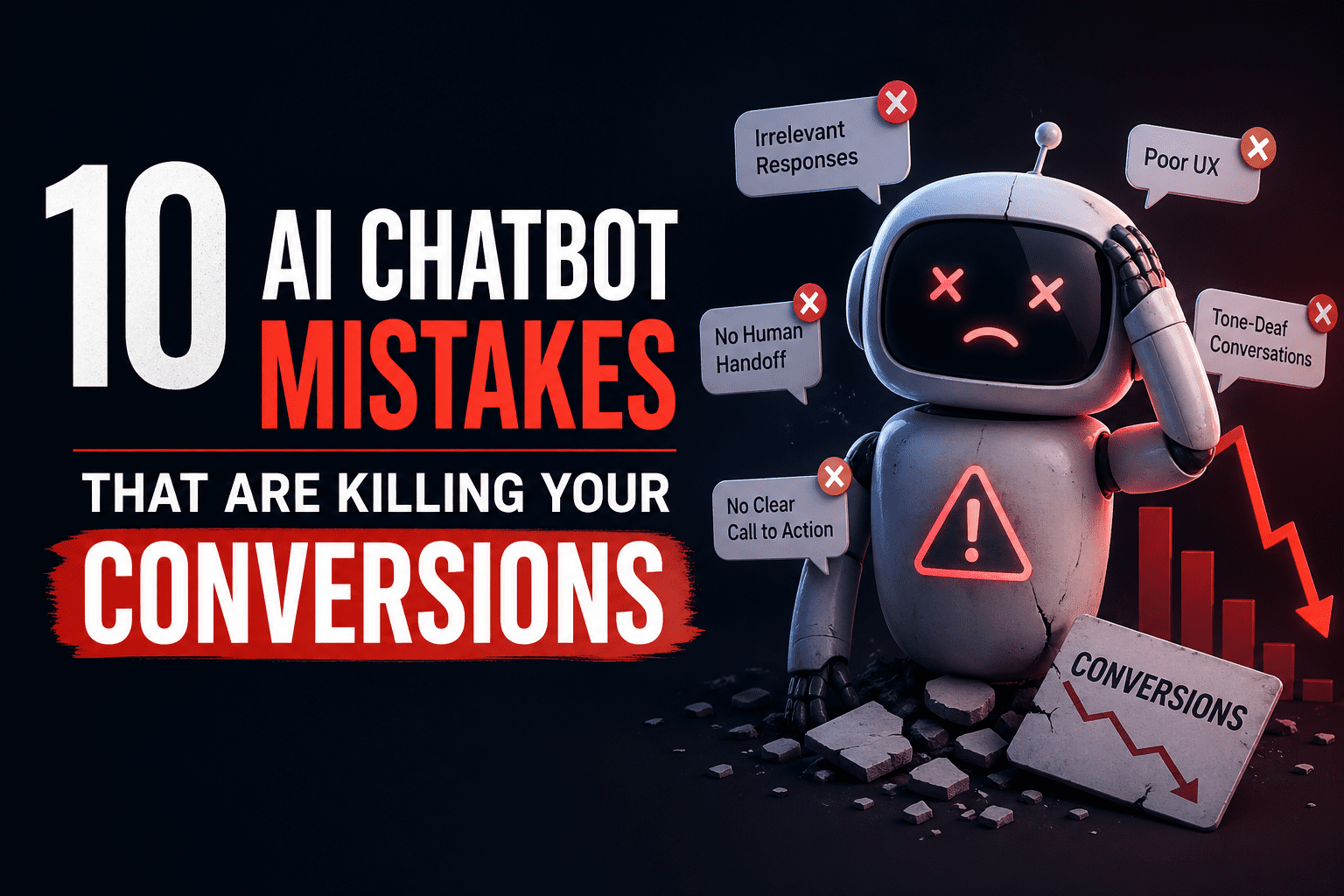
You spent money on a chatbot. You set it up. You watched it go live. And your conversion numbers went nowhere.
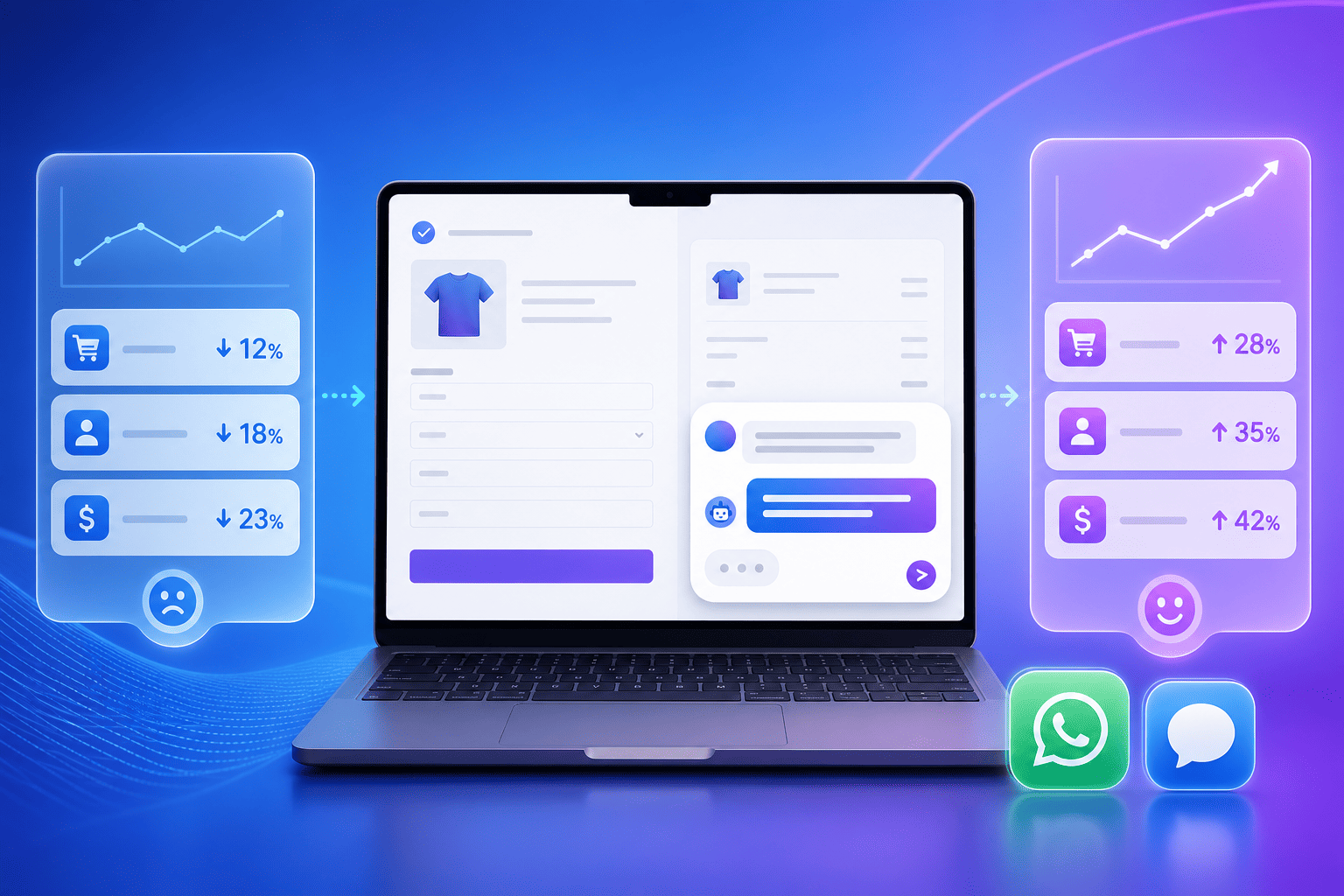
AI chatbot mistakes don’t announce themselves. They just quietly kill your results while you keep assuming the technology is the problem. It isn’t. A Glassix study found websites with well-deployed AI chatbots saw a 23% higher chatbot conversion rate than those without. So the potential is real. What’s not working is how most businesses set theirs up. Here are the ten mistakes worth fixing first, and what AI chatbot best practices actually look like when they work.
AI chatbot mistakes are configuration and design errors that prevent chatbots from turning visitors into leads or paying customers. The ten most damaging ones covered here include missing conversion goals, absent CTAs, robotic tone, broken escalation paths, bad trigger timing, and ignored analytics. Each one directly suppresses chatbot conversion rate performance.
AI Chatbot Setup Mistakes That Kill Results Before You Start
Mistake 1: No Clear Conversion Goal
What exactly is your chatbot supposed to do?
Not in a vague “help customers” way. Specifically. Because support automation, lead qualification, and direct sales conversion need completely different conversation designs. One bot trying to serve all three purposes usually ends up mediocre at all three.
Decide on one goal before you write a single message. Everything else follows from that. Miss this, and you are fixing problems for months that never needed to exist. Every AI chatbot best practice worth following starts here, and most failing deployments never got this far.
Mistake 2: Training It on Outdated Content
Wrong answers are worse than no answers.
A prospect asks about your pricing. Your bot quotes a plan you killed eight months ago. You didn’t just lose that lead. You told them your business doesn’t pay attention to itself. Update the knowledge base when things change. Not quarterly. When things change.
Mistake 3: Skipping Real User Journey Testing
Most teams test whether the chatbot responds. Almost nobody tests whether it responds correctly to the actual questions real users ask.
Real users don’t do that. They type weird. They start a question and abandon it. They come back on a different device three hours later, expecting the conversation to make sense. They ask something completely outside the scope of what you built for.
Test those situations before you go live. Not after the reviews come in. That’s how you avoid the AI chatbot mistakes that only show up once real people start using the thing. Noem.ai’s custom chatbot deployment process walks you through exactly how to test before going live.
Conversation Design Failures That Hurt Chatbot Conversion Rate
Mistake 4: Robotic Language That Pushes People Away
People know they’re talking to a bot. That’s fine. What’s not fine is when the bot keeps reminding them with every single message.
“I am an AI assistant here to help you with your inquiry today.” Nobody talks like that. Nobody wants to be spoken to like that either. Zendesk’s 2022 CX Trends report found that 60% of customers feel frequent disappointment when dealing with chatbots, and tone is a major factor. Write the way a sharp team member would actually speak. Short sentences. Real words. No corporate filler.
Fixing your tone costs nothing. Losing customers to a bot that sounds like a legal document costs plenty.
Mistake 5: Interrogating Users Before Helping Them
Four qualification questions before the bot has helped anyone with anything. That is not a sales funnel. That is an interrogation.
Masterofcode research on chatbot engagement shows poorly designed bots get 35 to 40% response rates. Well-designed ones hit 80-90%. The entire gap comes down to sequence. Give something useful first. Earn the right to ask questions after that. If your chatbot leads with “What’s your company size?” before solving a single problem, the redesign cannot wait.
To improve conversion rate using chatbot, help first and qualify. Every time.
Mistake 6: No Exit and No Escalation Path
Getting trapped in a chatbot loop is one of the most infuriating things a website can do to a visitor. Every flow needs a visible exit. Not buried. Right there.
When the bot can’t help, the human who picks it up should already know the full story. No repeating. No starting over. Zendesk research found that 46% of users say handoff failure is the most frustrating part of the experience.
Fix that before launch. Your chatbot conversion rate will thank you for it more than almost anything else on this list.
The Revenue Gap Nobody Talks About
Mistake 7: No Call to Action at the End of Conversations
Your bot answered the question. Great. Now what?
Most chatbots just… stop. Query resolved. Conversation closed. User left with no next step. That is not a support win. That is a missed sale you will never know you lost.
After a pricing question, offer the demo. After a feature question, surface the free trial. Every conversation has a natural close point. Put something there. Chatbot-led funnels convert 2.4 times higher than static web forms, according to Masterofcode chatbot research, when conversations close with a clear next step.
Configure your conversation endpoints with a CTA before you launch. Not as an afterthought. That is the difference between a chatbot that helps and one that actually converts. Your chatbot conversion rate lives or dies at the end of conversations, not the beginning.
Mistake 8: Wrong Trigger Timing
A popup the second someone lands on your homepage is not helpful. It’s annoying.
That same chatbot activating after 45 seconds on your pricing page is a completely different thing. Now it’s useful. Now it’s arriving when intent is already there.
Trigger logic based on scroll depth, time on page, or exit intent is one of the most underestimated levers in AI chatbot best practices. Set it based on behavior signals. Not on the assumption that every visitor wants to chat the moment they arrive.
Get the timing right first. Everything else in the flow matters a lot less if the bot shows up at the wrong moment.
Analytics Mistakes That Stop You From Improving Conversion Rate Using Chatbot
Mistake 9: Ignoring Conversation Data After Launch
You launched. Good. Now most people walk away.
That is the mistake.
Every conversation your chatbot has is data. Where users drop off. What questions keep coming up unanswered. Which flows escalate every single time. That is not background noise. That is your product telling you exactly what to fix.
Noem.ai’s sentiment and activity analysis reports surface those patterns every week. No data team needed. Just someone willing to look at what is actually happening and act on it.
Mistake 10: Treating the Chatbot as a Finished Product
The version you launched is a first draft.
That is not a criticism. It is just true. The chatbot that actually moves your chatbot conversion rate month on month is the one that improved 12 times after launch. Based on real conversations. Real drop-off points. Real user behavior.
Set a review rhythm. Look at what broke. Fix it. Then look again.
The businesses seeing strong returns from AI chatbot best practices are not the ones that got it perfect on day one. Nobody does. They are the ones who kept going after launch day.
Where to Go From Here
You now know what breaks a chatbot. More importantly, you know what to fix first.
Start with the goal. Just that. One clear outcome. Everything else you can figure out as you go, as long as you are actually looking at the data when you do.
None of that is complicated. What is complicated is watching your chatbot conversion rate stay flat while assuming the technology is letting you down.
It is not the technology. It rarely is.
Noem.ai gives you everything to build, deploy, and improve a chatbot that actually converts. No code. No big team. No enterprise budget. Just a platform built for lean teams that want a chatbot doing real work from day one.
If you have been sitting on a chatbot that is not performing, the setup guide is right here. Start there. Fix one thing at a time. The AI chatbot mistakes on this list did not all happen at once, and they do not all need fixing at once either.
Pick the biggest one. Fix it today.
Frequently Asked Questions
What are the most common AI chatbot mistakes that hurt conversions?
No clear goal, no CTA at the end of conversations, and wrong trigger timing. Those three cause the most damage. Add robotic language and no escalation path, and you have a bot that actively pushes people away. AI chatbot mistakes like these are not technical failures. They are setup failures.
How do I improve conversion rate using chatbot on my website?
Define one goal per conversation flow. Add a next step at every close point. Activate the bot based on behavior signals, not page load. When those three things are in place, the chatbot conversion rate gap between you and a poorly configured competitor widens quickly. Done right, chatbot conversations convert at more than double the rate of a standard contact form.
What are the AI chatbot best practices for lead generation?
Help before you qualify. Keep question sequences short. Use language that sounds like a person, not a policy document. Close every session with a relevant next step. Those are the AI chatbot best practices that actually move the needle on lead numbers. Everything else is secondary.
Why does my AI chatbot have a high drop-off rate?
Usually one of three things. Too many questions before any value is delivered. Responses that miss the user’s actual question. No visible way out when the bot hits its limit. Fix the sequence, tighten the language, and add a clear escalation path. Drop-off does not fix itself.
When should an AI chatbot hand off to a human agent?
When it fails to resolve something after two attempts, when the user sounds frustrated, or when the question involves a purchase decision or a complaint, the handoff needs to carry the full conversation across. If the human agent starts from scratch, you have already lost that customer. That single detail matters more than most businesses realize when thinking about how to improve conversion rate using chatbot.