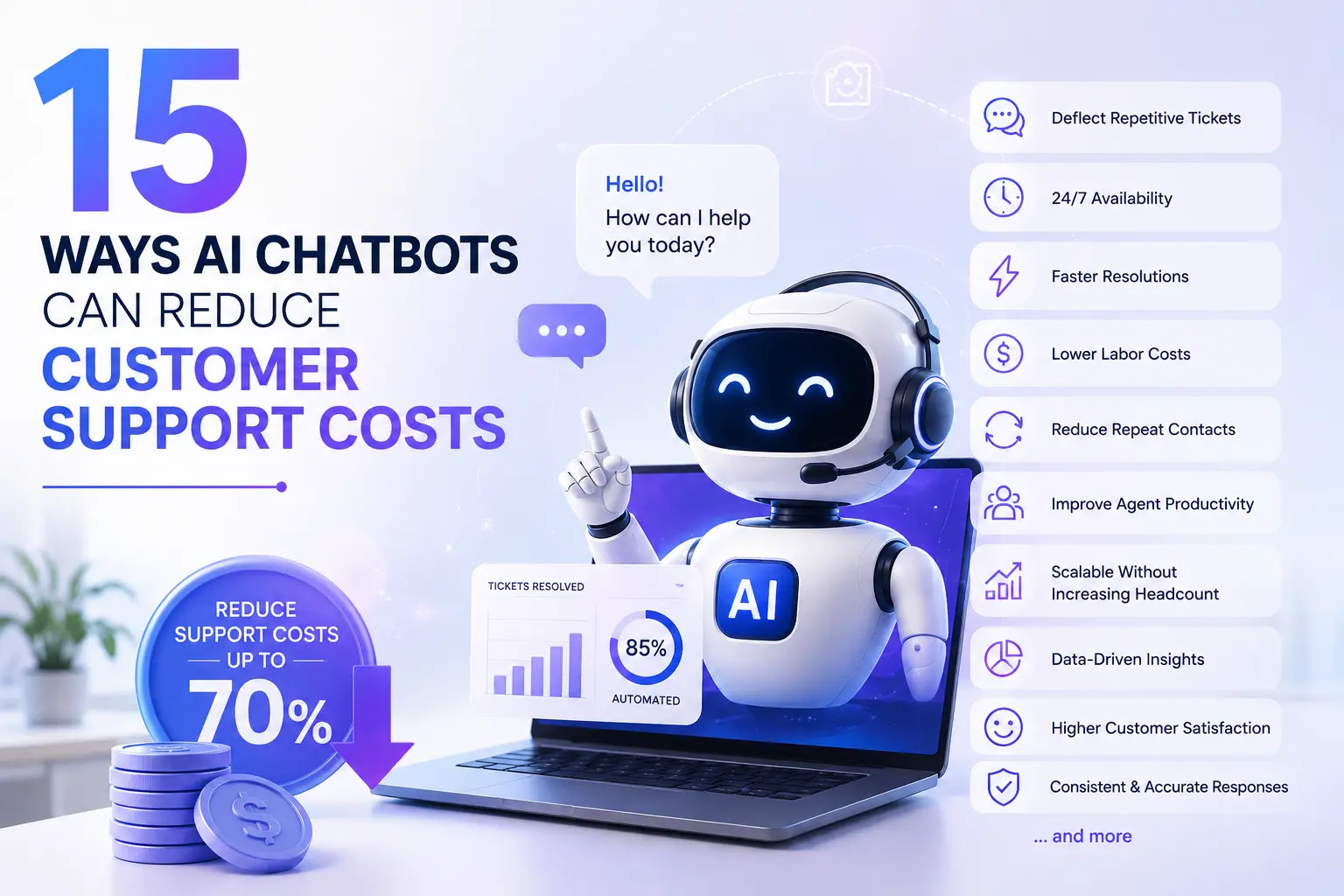
Maintaining a support team is a major financial burden. Costs for salaries, benefits, and training rise quickly, especially when factoring in night-shift premiums and high agent turnover. Research from Gartner indicates that labor can represent up to 95% of total contact center expenses. Because of this, businesses use AI chatbots for customer support as a primary tool to reduce operational spending. This AI customer support platform enables this transition without the need for developers, massive budgets, or lengthy setup times.
So, how exactly do AI chatbots reduce customer support costs? They deflect repetitive tickets and remove the need for late-night staffing. Implementing a chatbot for customer service can slash the cost per interaction from $15 down to just a few cents. This move toward customer service automation ensures human agents focus on complex tasks that require actual expertise. Gartner predicts that automated customer service will help reduce global labor costs by $80 billion by 2026.
Here are 15 specific ways that happen.
How AI-Powered Chatbots for Customer Support Cut Costs: The Full Picture
Before breaking down each method, here is a quick reference snapshot of all 15 cost-reduction mechanisms and where each one hits hardest on your budget.
| # | Cost-Reduction Method | Primary Budget Impact |
|---|---|---|
| 1 | Deflecting repetitive tickets | Volume and labor costs |
| 2 | Eliminating after-hours staffing | Overtime and shift premiums |
| 3 | Cutting repeat contacts | Wasted ticket handling |
| 4 | Reducing agent handle time via pre-triage | Labor efficiency |
| 5 | Scaling volume without headcount growth | Hiring and onboarding |
| 6 | Lowering agent turnover through burnout reduction | Recruitment and retraining |
| 7 | Multichannel support from one platform | Infrastructure and tooling |
| 8 | Faster first-contact resolution | Escalation and re-handling costs |
| 9 | Proactive support that prevents contacts | Inbound ticket volume |
| 10 | Sentiment-aware escalation | Misrouted ticket costs |
| 11 | Real-time analytics revealing cost drivers | Inefficiency spend |
| 12 | Eliminating outsourcing dependency | Third-party service fees |
| 13 | Consistent answers reduce compliance risk | Error and rework costs |
| 14 | Self-service enablement at scale | Agent time per interaction |
| 15 | Compounding ROI over time | Total cost of support ownership |
How AI Chatbots Cut Customer Service Automation Costs Most Effectively
1. AI Chatbots Deflect the Tickets That Eat Your Budget
It is a known headache in support: roughly 60% to 80% of your daily tickets are just the same handful of questions on loop. Whether it is someone checking an order status or asking for a password reset, having a human handle those basic tasks costs anywhere from $8 to $15 every single time.
By contrast, an AI-powered customer support chatbot knocks these out instantly. Since they cost about $0.50 per interaction, the math looks very different. If you can deflect 500 of those repetitive tickets every week, you are looking at massive monthly savings without even touching the rest of your business model.
2. Eliminate After-Hours Staffing Costs
Running a support desk through the night or over weekends is a major drain on resources. Most companies either pay high premium rates for those shifts or just let customers wait, which usually ends in frustration. A chatbot for customer service solves this by staying active 24/7. It does not require overtime pay or holiday bonuses. Because it handles those late-night queries independently, your human staff never has to touch them, saving you from those expensive off-hour expenses.
3. Cut the Cost of Repeat Contacts
Different agents give different answers. When that happens, customers call back. That second ticket costs the same as the first and solves nothing new. Automated customer service pulls from one consistent knowledge base. It gives the same answer at 9 am on Monday as it does at 2 am on Sunday. Your repeat contact rate falls, and so does your bill.
4. Reduce Agent Handle Time With Pre-Triage
Before a human joins the chat, the AI chatbot for customer service has already collected the name, account details, and issue type. Your agent skips the setup and gets straight to the fix. Zendesk data shows faster resolutions directly lift customer satisfaction scores. Your team handles more tickets in the same shift without anyone working harder.
5. Scale Volume Without Scaling Headcount
More customers used to mean more hires. That math has changed. SciTePress research confirms customer service bots handle up to 70% of routine queries without any human input. A business that doubles its customer base no longer has to double its support budget to keep up.
6. Lower Agent Turnover by Reducing Burnout
Support centers lose between 30% and 45% of their agents every year. Replacing one costs roughly half their annual salary once recruiting, onboarding, and the productivity gap are factored in. That number rarely appears in cost-reduction conversations, but it should. Answering the same five questions on repeat, hour after hour, is what drives good agents out. When AI-powered chatbots for customer support take on that workload, your team can spend its time on problems worth solving. Retention improves, and a cost most businesses quietly accept starts to shrink.
7. Multichannel Support From a Single Platform
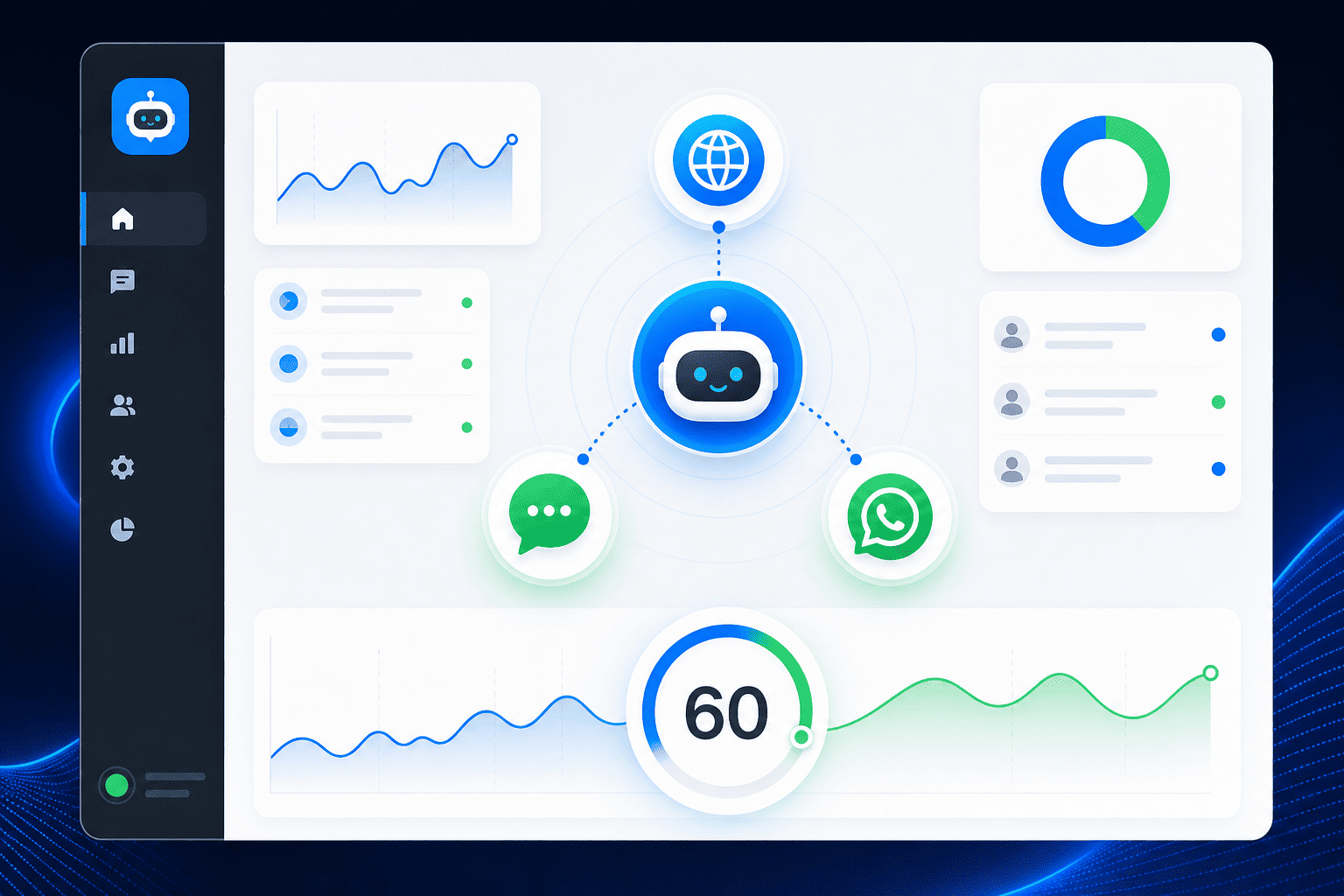
Running separate tools for live chat, email, SMS, and WhatsApp means paying for multiple platforms, training staff across all of them, and hoping the experience stays consistent. Noem.ai’s multichannel publishing and auto-sync features bring your entire automated customer service operation into a single dashboard, with no per-seat charges or hidden fees. You cut tooling costs, reduce training overhead, and keep every customer touchpoint running from the same place. Plans start free, with the top tier at $99 per month.
8. Faster First-Contact Resolution Cuts Escalation Costs
Every escalation adds cost. A ticket that moves from chatbot to junior agent to senior agent has been paid for three times over. AI chatbots for customer support resolves issues at the first touchpoint and stop that chain before it starts. Klarna’s AI-powered chatbot for customer support handled two-thirds of all customer service chats independently in 2024, delivering the equivalent output of 700 full-time agents and an estimated $40 million in profit improvement. First-contact resolution is the number that drives everything else down. Track yours using this chatbot performance guide.
7 More Ways Customer Service Bots Reduce Operating Costs
| # | Method | How It Saves Money |
|---|---|---|
| 1 | Proactive support: The bot surfaces relevant help before the customer contacts you, based on behavior patterns on your site. Prevents tickets from forming in the first place. | Reduces inbound volume at the source |
| 2 | Sentiment-aware escalation: Instead of routing every frustrated customer to a general queue, sentiment-detection routes high-risk interactions to your best agents immediately. Fewer misrouted tickets means fewer costly re-escalations. | Cuts resolution time on high-value cases |
| 3 | Real-time analytics: Noem.ai’s analytics dashboard flags which query types generate the highest ticket volume and where resolution is failing. You fix the root cause, not just the symptom. | Converts repeat-failure spend into targeted cost reduction |
| 4 | Eliminating outsourcing dependency: Companies using third-party support providers pay per agent, per interaction, and per language. An AI-powered chatbot for customer support handles multilingual queries at no additional per-interaction cost. | Removes outsourcing markups entirely |
| 5 | Consistent, compliant answers: Human agents under pressure make mistakes. Incorrect information leads to rework, compensation, and, in some cases, regulatory exposure. Automated customer service bots follow your approved responses precisely, every time. | Reduces error-driven rework and risk costs |
| 6 | Self-service enablement: When customers resolve their own queries through a bot, your cost-per-contact drops to near zero for those interactions. According to SurveyMonkey, the majority of customers prefer solving problems without contacting support when a fast, accurate self-service option is available. | Eliminates agent involvement entirely |
| 7 | Compounding ROI over time: Human support costs compound every year through salary increases, additional benefits, and higher training costs. The cost of running an AI chatbot for customer service stays flat or decreases as the platform improves. The savings gap between AI and human-handled interactions widens every year, not just on day one. | Grows your return without growing your costs |
The Real Cost of Not Using AI in Customer Support
Most cost conversations focus on what AI saves you. Fewer articles ask what the absence of AI costs you right now.
Consider what happens without customer service automation:
- Queries that arrive at 11 pm sit unanswered until morning, and some customers do not wait
- Inconsistent answers generate repeat contacts that cost the same as new tickets
- Agents spend the majority of their shifts on low-value questions they find demoralizing
- Your support cost grows in direct proportion to your customer base, with no way to break that relationship
The Buildfire case study shows exactly what changes when a business switches. The cost of inaction compounds just as steadily as the ROI of action.
Start Reducing Customer Support Costs With Noem.ai
The fastest way to reduce support costs is not to cut corners on service. It’s to stop routing simple, predictable questions through expensive human infrastructure. Noem.ai’s no-code setup, usage-based pricing, and single-dashboard management make it straightforward for any business to deploy AI-powered chatbots for customer support without a development team or a six-figure budget. Start free and scale only when the savings justify it, which they will. See what Noem.ai can do for your support costs.
Frequently Asked Questions About AI Chatbots for Customer Support
How much can AI chatbots actually reduce customer support costs?
AI-powered chatbots for customer support typically reduce operational costs by 25% to 30% for businesses that deploy them strategically. The savings come from a mix of ticket deflection, reduced agent handle time, and eliminated after-hours staffing costs.
Are AI chatbots effective for customer service in small businesses, or are they only for large enterprises?
Customer service bots work well at any scale. Small businesses often see the highest proportional savings by replacing expensive per-agent costs with an affordable flat subscription. A business spending $3,000 to $4,000 per month on a support agent can automate 60% to 70% of their routine queries for a fraction of that cost.
How do AI chatbots handle questions they cannot answer?
A well-configured AI-powered chatbot for customer support recognizes its limits and escalates to a human agent at the right moment. Platforms with sentiment-aware responses, like Noem.ai, go further: they detect frustration or urgency in real time and route those conversations to your best available agents before the situation deteriorates.
Will automated customer service hurt my customer satisfaction scores?
Not if you deploy it correctly. Speed and accuracy are what drive satisfaction scores, and automated customer service delivers both consistently. Zendesk research shows 51% of consumers already prefer interacting with bots when they need immediate help. When customers get fast, accurate answers, CSAT scores hold or improve.
What is the difference between a basic chatbot and an AI-powered chatbot for customer support?
A basic chatbot follows a fixed decision tree and fails whenever a customer asks a question outside its script. An AI-powered chatbot for customer support uses natural language processing, which is the technology that lets software read and understand human language, to interpret intent, pull relevant information from your knowledge base, and generate accurate, context-aware responses. The cost savings from AI in customer support come almost entirely from this ability to handle real, varied customer language without breaking.