Your support bot just told a paying customer to “please refer to our FAQ page.” They didn’t. They left. That moment, repeated thousands of times a day across thousands of businesses, is exactly why replacing chatbots with AI agents has stopped being a future conversation.
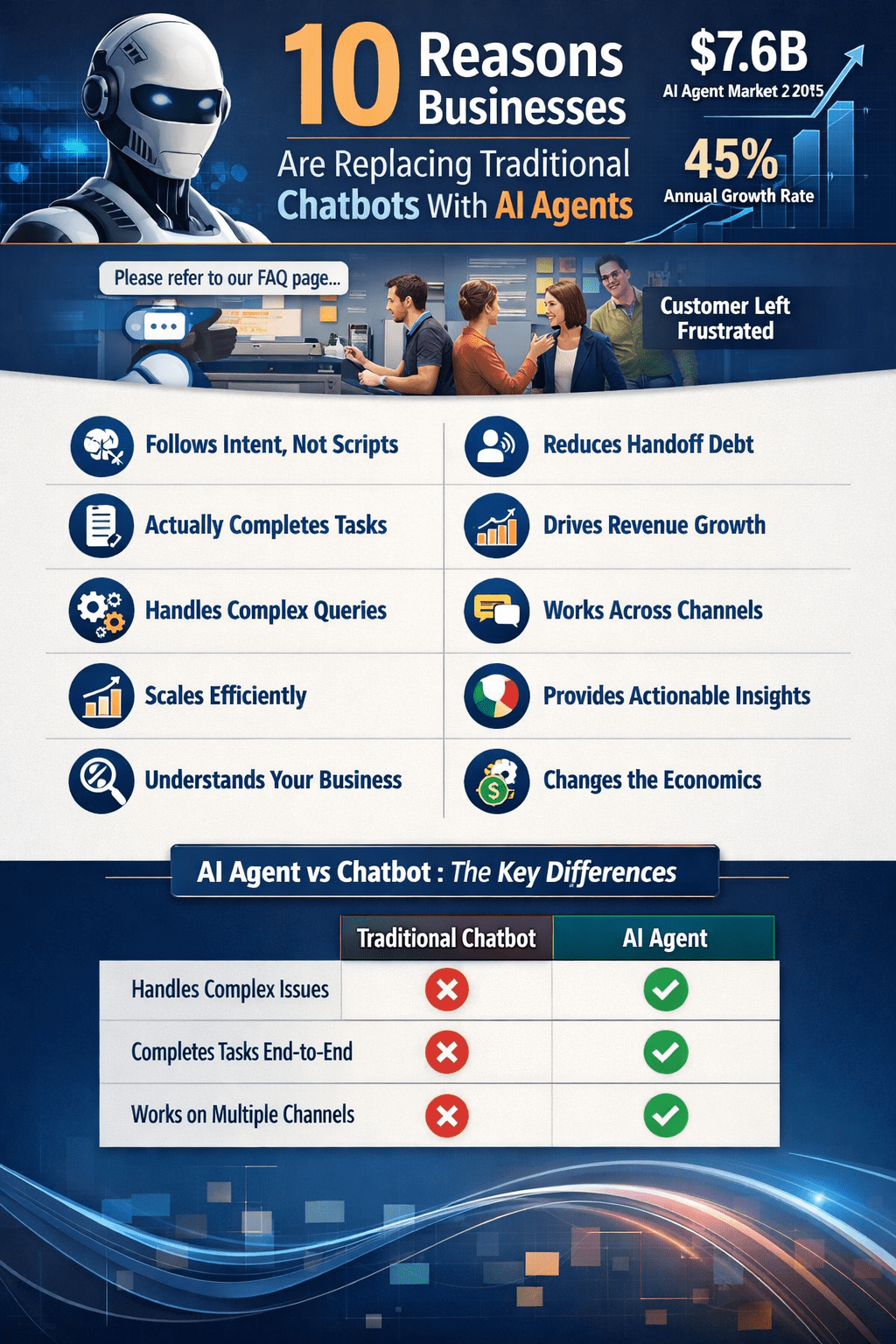
The global AI agents market hit roughly $7.6 billion in 2025 and is growing at nearly 45% annually. Businesses ran the experiment, saw the results, and didn’t go back. That’s what’s driving the number.
1. Traditional Chatbots Follow Scripts. AI Agents Follow Intent.
Drift built its whole early product on decision trees. Users would type something the bot wasn’t expecting and hit a wall. Nothing useful came back. Support tickets went up. The bot didn’t change.
AI agents don’t work that way. They pick up on what someone means, not what they typed word-for-word. A complaint that’s half-finished, badly phrased, and full of typos still gets where it needs to go. There’s no branch to fall off of anymore.
2. AI Agents Actually Complete Tasks. They Do Not Just Respond.
Rescheduling a delivery? Updating an order? Chatbots still can’t do it. You ask, and it sends you a link to a form. You fill out the form. Someone processes it later. Maybe.
McKinsey found that applying generative AI to customer care functions could unlock productivity savings of 30 to 45%. Those savings come from task completion, not faster typing. An AI agent just does it. Checks the system, finds the slots, reschedules, updates the record, and confirms back to you. Same conversation. Nothing handed off, nothing followed up, nothing lost in a ticket queue that nobody’s watching. See how AI agents handle ecommerce operations end-to-end.
3. Chatbots Break at Complexity. AI Agents Are Built for It.
A chatbot handles one thing at a time. It has no memory of what was said two exchanges ago. Ask it a question involving two systems or three conditions, and it loops, deflects, or gives you a generic answer.
AI agents hold context across a full conversation. “I want to upgrade my plan, but I’m not sure which one fits, and also, I had a billing issue last month.” The agent handles all three threads without losing the plot. For founders managing support without a full team, this single capability changes everything. Explore how founders are using AI agents to replace manual support.
4. The AI agent vs chatbot Differences Show Up Hardest at Scale.
Scaling a chatbot doesn’t fix what’s broken about it. You get more of the same conversation, the same dead end, the same hand-off to a person who has to pick up what the bot dropped. The volume goes up. The resolution rate doesn’t.
AI agents close conversations. Not most of them. The ones that used to bounce straight to your team after the bot gave up. That’s where the queue starts shrinking. That’s the clearest AI agent vs chatbot gap you’ll see in a live operation.
5. AI Agents Understand Your Business. Chatbots Understand Your Keywords.
A chatbot is trained on keywords. Match the phrase, trigger the response. Miss the phrase, trigger nothing useful. So “can I get a refund” works, but “I’d like my money back” sometimes doesn’t.
AI agents are trained on your business: your products, your policies, your tone, your common customer scenarios. When a user asks something phrased in a way you never anticipated, the agent still knows how to respond because it understands the underlying logic of how you operate. See how this plays out in real conversations among educators and coaches.
6. Traditional Chatbots Create Handoff Debt. AI Agents Reduce It.
Every time a chatbot can’t resolve something and passes it to a human, that’s a handoff. Handoffs cost time, money, and the customer’s patience. With traditional chatbots, most conversations end in one because the bot was built only for tier-one queries.
AI agents close those conversations, not by escalating anyway, but by actually working through the issue until it is done. One tool creates handoff debt. The other eliminates it.
7. AI Agents Drive Revenue. Chatbots Just Protect It.
A chatbot’s job is to deflect. Keep tickets out of the queue. Keep costs down. It is a defensive tool that plays defense. Nothing wrong with that, except it stops there.
AI agents do not stop there. During a support conversation, an AI agent can recognize a buying signal and act on it. A customer troubleshooting their subscription tier might be ready to upgrade. The agent picks that up. Most chatbots don’t. Marketing teams are seeing this across every channel.
8. AI Agents Work Across Channels. Chatbots Are Usually Stuck to One.
Your customers are on your website, WhatsApp, SMS line, and social pages, sometimes all in the same day. A traditional chatbot lives in a widget on your website. Getting it to behave anywhere else requires a separate build, separate training, and usually a separate budget.
One trained core, every channel. A customer who starts a conversation on your website and follows up on WhatsApp gets the same agent, the same context, the same answers. Nothing resets. Nobody asks them to start over.
For health and wellness businesses, that matters more than most. Bookings, follow-ups, intake questions and post-session check-ins, those conversations don’t all happen in the same place. See how AI agents support health and wellness businesses across every channel.
9. AI Agents Surface Business Intelligence. Chatbots Just Log Conversations.
A chatbot logs conversations, if you set it up to. And then the logs sit unread unless someone manually pulls a report.
AI agents analyze conversations and automatically surface patterns. What are customers confused about most? What objections come up before a purchase? The agent does not just answer those questions in chat. It reports on them weekly so you can act on the data.
10. Replacing Chatbots With AI Agents Changes the Economics.
Traditional chatbots reduced costs by deflecting easy queries, then created a second layer of human support to handle everything the bot dropped, which absorbed most of the savings.
Replacing chatbots with AI agents changes the unit economics entirely. The agent handles a wider range of issues without escalation, so your human team can focus on genuinely complex cases rather than cleaning up bot failures. The cost argument is not “cheaper than before.” It is “capable of things that were not economically possible before.”
The AI Agent vs AI Chatbot Comparison at a Glance
| Capability | Traditional Chatbot | AI Agent |
| Handles complex queries | No | Yes |
| Remembers the conversation context | No | Yes |
| Completes multi-step tasks | No | Yes |
| Works across multiple channels | Rarely | Yes |
| Surfaces business insights | No | Yes |
| Drives revenue during support | No | Yes |
What to Do Next
You’ve already been through this. You know the drill by now. The bot keeps punting a certain ticket type to your team. You’ve noticed and probably added more flows to try to patch it. Probably didn’t help much.
That’s not a setup problem. AI agents aren’t a patched version of what’s already there. They’re different tools for different jobs. Most people start with whatever’s failing loudest. That tends to be the right call.
Frequently Asked Questions
What is the main AI agent vs chatbot difference?
A chatbot is looking for a keyword. Find it, return the response. Miss it, return something useless. Most customers miss it. That’s the AI agent vs chatbot difference in practice.
An AI agent isn’t scanning for triggers. It’s tracking what the person actually needs throughout the conversation and taking action. That’s the part traditional bots were never built for.
Can AI agents replace human support teams entirely?
Not entirely, and that’s not the goal. AI agents handle high-volume, repeatable interactions that consume most of a support team’s time. They escalate to humans when a situation genuinely requires judgment or authority that the agent can’t provide. Your human team ends up focused on work that actually needs them.
How are businesses replacing chatbots with AI agents without disrupting operations?
Most start by deploying an AI agent alongside their existing setup, training it on current product knowledge and common queries. Platforms like Noem.ai are built for fast setup, with live deployments possible in under an hour and no coding required.
Is replacing chatbots with AI agents expensive?
Noem.ai starts free. Full access is $99 a month, no per-seat fees.
The trickier number to track is what’s already walking out. A customer who hit a dead end at 11 pm. An escalation your team handled because the bot gave up. Most of that never makes it into a report. It just shows up later in churn.