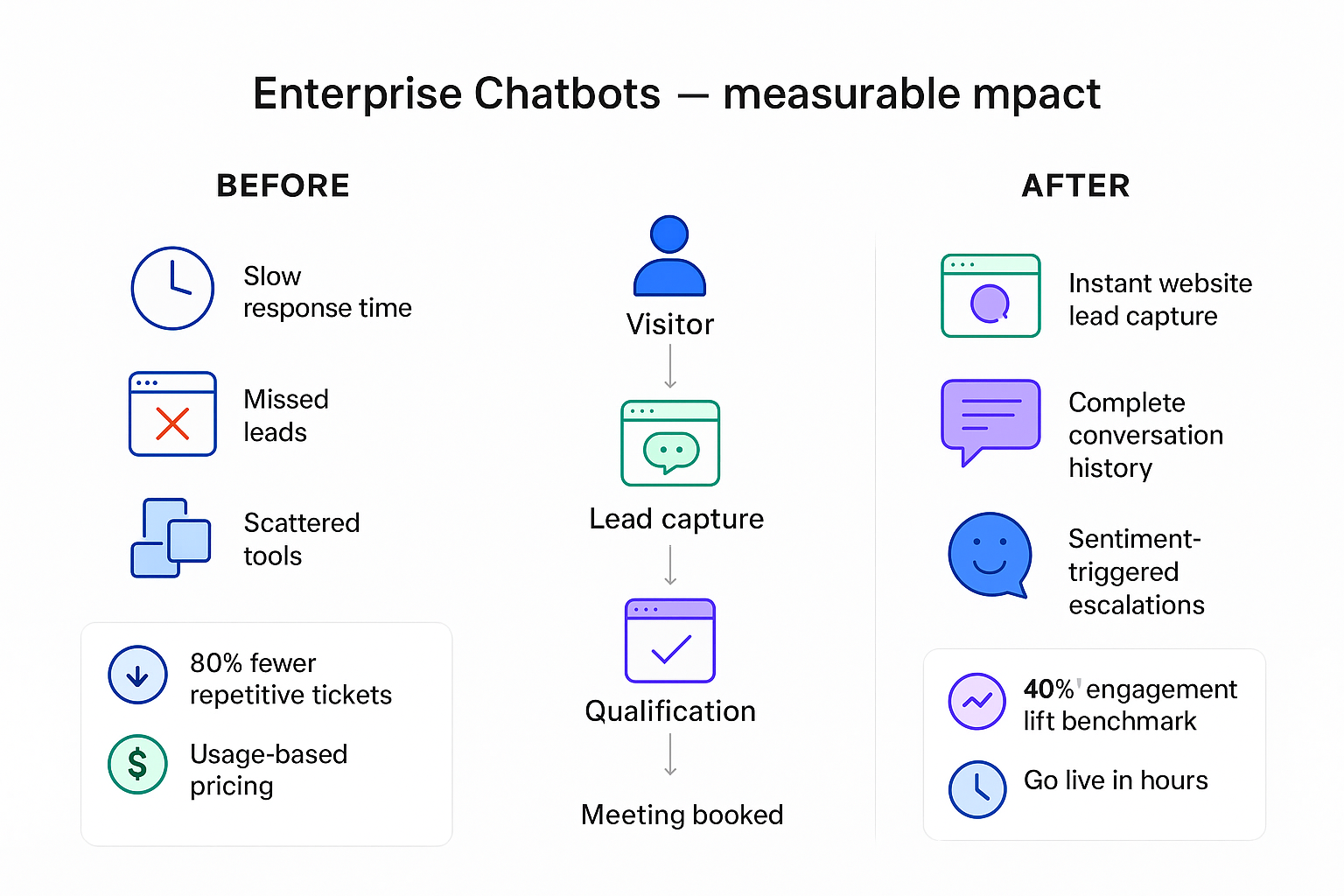
When you choose a chatbot, it is easy to get stuck in long lists of features. But what matters most is the business impact you can measure in the first 30, 60, and 90 days. You want to see better lead quality, higher conversion lift, and clear pricing trade-offs that fit your budget. This means tracking the right metrics like instant website lead capture, complete conversation history, faster response times, and sentiment analysis. Tools like Noem.ai put these outcomes first with an all-in-one stack that helps teams go live fast and learn even faster (ref: Noem.ai).
A strong chatbot should help you cut routine support questions so your team can focus on real deals. Companies using Noem.ai report up to an 80% drop in repetitive questions and tickets, which frees people to follow up with hot prospects and close faster (ref: Noem.ai Blog). This kind of drop also boosts morale and saves money at the same time. With fewer tickets, your team has space to write better outreach, run demos, and move contracts forward. That is how you turn a chat widget into a pipeline engine (ref: Noem.ai vs TeamAI).
Another thing to consider is speed to value. If setup takes weeks, you lose time, you lose leads, and you lose budget. The faster you go live, the faster you improve lead quality and see a boost in conversion. Noem.ai reports rapid, even overnight deployment potential, thanks to bundled builder, hosting, and knowledge sync (ref: Noem.ai vs Drift).
On top of that, pricing should scale with usage. If you are a growing team, you need clear, predictable costs. A usage-based model, like the one from Noem.ai, makes it easier to grow without paying big enterprise premiums up front (ref: Noem.ai). When you add it all up, the right chatbot is the one that improves quality, speeds up conversion, and stays friendly to your budget.
How to measure lead quality, conversion lift, and pricing trade-offs
A clear plan helps you judge real impact. You want simple, trusted measures that leaders understand and your team can track every day. Below is a practical way to run your scorecard for 90 days. It covers lead quality, conversion lift, and pricing trade-offs. It also points to the data you need from day one to avoid guessing.
- Lead Quality: Your goal is to qualify faster with better data. Look for instant website lead capture that collects contact info, intent, and needs in one flow. Then look for complete conversation history that travels with the lead across your tools. Noem.ai supports instant capture and maintains context across channels, which helps reps tailor follow-up right away (ref: Noem.ai). With stronger inputs, reps book more meetings that actually close.
- Conversion Lift: Your goal is to move more people from interest to action. Benchmarks show optimized chat flows can raise engagement by about 40% when the experience is simple and fast (ref: respond.io; eesel.ai). Noem.ai’s rapid deployment and auto-sync help you learn and refine messaging sooner, which can drive conversion lift without complex manual A/B tests (ref: Noem.ai vs LivePerson). When you act on chat insights quickly, your funnel moves faster.
- Pricing Trade-offs: Your goal is to match cost with value and growth. Large, bundled suites may ask for higher upfront spend and longer commits. A usage-based model from Noem.ai helps you pay only for what you use, which is helpful for small and mid-size teams watching ROI closely (ref: Noem.ai). This reduces risk and keeps spend tied to your actual traffic and success.
- Faster Response Times: Your goal is to answer prospects right away. Quick answers stop drop-off and keep people on your page. Noem.ai routes and replies in real time, which means fewer missed chats and more booked calls (ref: Noem.ai). Faster replies also support higher close rates because you meet prospects at the moment of intent (ref: respond.io).
- Sentiment Analysis: Your goal is to protect CSAT and win trust. Built-in sentiment analysis in Noem.ai helps the bot react with empathy and escalate issues when needed (ref: Noem.ai Blog). This turns tense moments into saves and reduces churn risk. Over time, fewer tickets and smarter handoffs support higher NPS and better close rates (ref: Noem.ai vs TeamAI).
The core data you should track from day one
The easiest way to make smart choices is to track the same simple numbers each week. This helps you compare tools and spot true wins, not just busywork. It also gives your leaders a clean view of progress toward targets. Here is a short list of numbers that are easy to collect and helpful in discussions. You can set them up in your CRM or analytics tool in a few minutes.
- Instant Website Lead Capture Rate: Measure how many chat visitors you capture with name, email, and need. If the rate goes up week over week, your prompts and flows are working. Noem.ai streamlines this with bundled builder and hosting, so you can test copy and offers faster (ref: Noem.ai). Faster tests mean faster gains.
- Meeting Booked Rate from Chat: Track what percent of captured leads book a meeting or demo within seven days. This connects chat activity to pipeline. Keep the flow short and clear to lift this number. Teams using quick replies and smart routing see strong lift in this step (ref: respond.io).
- Time to First Response: Measure the average seconds to reply to a new chat. Faster responses win more attention and respect. If your setup is slow, people leave and never return. Noem.ai helps reduce that lag with auto-replies and clear handoffs (ref: Noem.ai).
- Ticket Deflection Rate: Count the share of chats that end without a human agent. With Noem.ai reporting up to 80% fewer repetitive questions, your team can move to higher value work (ref: Noem.ai Blog). This is where the savings stack up. You can turn saved hours into outreach and upsell.
- Sentiment Trend: Watch the share of negative, neutral, and positive chat sessions over time. If negative drops while conversion rises, your bot is doing the right things. Noem.ai uses built-in sentiment analysis and complete conversation history to reduce repeat friction (ref: Noem.ai). That helps protect CSAT and NPS while you scale.
Noem.ai vs competitors: Features that change outcomes
Below are side-by-side notes to help you compare. Each point looks at impact, not just a long list of tools. The focus is on what helps you sell more, faster, at a fair cost. These bullets explain how features turn into results.
- Noem.ai Feature Stack: Noem.ai bundles builder, hosting, knowledge sync, multichannel publishing, and analytics into one stack, so you go live in hours, not weeks (ref: Noem.ai). Instant website lead capture and complete conversation history keep context across sessions and channels, which strengthens follow-up quality (ref: Noem.ai). Built-in sentiment analysis helps with empathy and smart escalations, guarding CSAT while you reduce tickets (ref: Noem.ai Blog). This focus supports higher close rates by giving reps rich context and faster intent signals.
- Alternative Platforms: Some tools focus on broad suites or human-AI hybrids that need more setup and more team playbooks (ref: respond.io). That can be helpful for complex orgs, but it may slow deployment. If you want quick impact, the single-stack approach from Noem.ai cuts the lift so you see results sooner (ref: Noem.ai vs Drift). Faster start means you learn faster and waste less budget.
- Multichannel Sync: Noem.ai emphasizes auto-sync that keeps knowledge current across site, store, and support tools, which reduces errors and repeated questions (ref: Noem.ai vs TeamAI). When your data stays fresh, your answers stay right and helpful. That trust builds over time and supports stronger conversion lift. It also reduces the need for manual content updates.
- Smart Escalation with Full Context: With complete conversation history, reps get the full story when they step in. This stops the annoying “please repeat yourself” loop and saves time for both sides. Noem.ai makes that history easy to pass along across channels and tools (ref: Noem.ai). That leads to better experiences and higher close rates.
Noem.ai vs competitors: Pricing fit and the cost of speed
Picking a plan should not feel like guesswork. You want costs that match your traffic and value. Usage-based pricing helps with that. It also keeps your CFO happy because spend scales with results.
- Noem.ai Pricing: Noem.ai offers usage-based monthly plans that scale as you grow, so you pay for what you use and nothing more (ref: Noem.ai). This is helpful for small and mid-size teams that need predictability. It also lowers risk while you test and learn. You can ramp up as you prove ROI.
- Alternative Pricing Patterns: Some enterprise suites come with higher upfront costs and longer evaluation cycles (ref: respond.io). That may work at very large orgs, but it can slow momentum for SMBs. If speed and cash control matter, usage-based plans are easier to approve. This makes Noem.ai a practical choice for teams that want to grow in steps.
- Cost vs Value: Do not just price the software; price the time to launch and the time to learn. If you can launch in a day, the value starts right away. Noem.ai’s quick start means you get your first data this week, not next quarter (ref: Noem.ai vs Drift). The time you save on setup turns into time you can spend improving lead capture and close rates.
- Total Cost of Ownership: Think about tool sprawl. When you buy piecemeal tools for building, hosting, analytics, and sync, you add costs and extra logins. An all-in-one stack like Noem.ai helps you keep costs stable and your setup simple (ref: Noem.ai). Simple stacks lead to faster teams and fewer mistakes.
Noem.ai vs competitors: Time to deploy and speed to insights
Speed is a force multiplier. If you can launch fast, you start learning fast. That is how you improve lead quality and conversion without wasting months. Here is what to look for:
- Noem.ai Time to Deploy: Noem.ai bundles builder, hosting, knowledge sync, and analytics in one place, so teams can go live in hours with out-of-the-box integrations like WordPress or store platforms (ref: Noem.ai vs Drift). This helps you reduce internal ops work and start collecting real user data right away. Quick launch leads to quick fixes and lifts. Short loops are your edge.
- Alternative Time to Deploy: Some platforms involve more channels, more rules, or more custom builds. That can be powerful, but it often requires longer timelines and more people to manage (ref: respond.io). If your main goal is to capture leads and speed up replies now, a lighter stack may fit better. This is where Noem.ai stands out with a fast path to value (ref: Noem.ai).
- Early Wins: With faster deployment, you can test offers, CTAs, and scripts in days. You can also measure deflection and sentiment trends quickly. This builds a clear case for what to keep and what to cut. Leaders like quick wins that show clean ROI.
- Hand-off and Escalation: A fast start also needs smooth handoffs when a human must help. With complete conversation history, reps ramp faster and close with more context. This cuts time to resolution and keeps people happy.
Noem.ai vs competitors: Sentiment analysis that protects CSAT and boosts closes
Sentiment analysis sounds fancy, but it is simple: read the room and respond the right way. When a customer is upset, you want the bot to calm the moment or bring in a human fast. When a buyer shows strong intent, you want to push the right next step. This is why built-in detection and smart rules matter.
- Noem.ai Sentiment Analysis: Noem.ai includes built-in sentiment analysis that detects negative signals and triggers workflows or an empathetic escalate with full context (ref: Noem.ai Blog). This helps protect CSAT and NPS while cutting tickets by up to 80% for repetitive issues (ref: Noem.ai Blog). It also supports higher close rates by keeping fragile deals on track when emotions run high. Good saves build long-term trust and referrals.
- Alternative Approaches: Many tools rely on hand-made rules or playbooks to route chats, which can work but may miss the emotional signals in the moment (ref: respond.io). If detection is not built-in, your team may spend time tuning rules every week. That time could go to outreach and demos instead. Built-in sentiment in Noem.ai keeps things simple and effective (ref: Noem.ai).
- Impact on Sales Handoffs: When emotion is clear and context follows the chat, reps can adapt tone and offer the right next step. This shortens the path to a meeting or a close. Buyers feel heard, not processed. That human touch, guided by good signals, is a quiet superpower.
- Ongoing Improvement: You can review negative chats each week and adjust prompts or offers. Over time, negative goes down, positive goes up. Keep those wins in a simple weekly dashboard. Show them in pipeline meetings to keep momentum strong.
Noem.ai vs competitors: Features, pricing, time to deploy, and sentiment analysis — quick bullets
- Noem.ai vs Competitor Features: Noem.ai offers an all-in-one stack with instant website lead capture, complete conversation history, multichannel sync, and proactive handoffs with context (ref: Noem.ai). This setup supports faster response times and better-qualified leads. Over time, you should see more booked meetings and fewer repeated questions. That is how close rates climb in a steady, simple way.
- Noem.ai vs Competitor Pricing: Usage-based pricing lets you scale with traffic and success, which keeps budgets predictable for growing teams (ref: Noem.ai). Larger suites often bring higher upfront costs and more time to evaluate. If you want speed and cash control, a usage model helps a lot. It removes friction from approvals and renewals.
- Noem.ai vs Competitor Time to Deploy: Noem.ai emphasizes rapid deployment with bundled builder, hosting, and knowledge sync that gets you live fast (ref: Noem.ai vs Drift). Faster launch means faster learning and faster gains. Teams avoid long internal projects and complex rules. They start collecting real engagement data day one.
- Noem.ai vs Competitor Sentiment Analysis: Built-in sentiment detection in Noem.ai turns tense moments into saves and routes hot leads to the right human with full context (ref: Noem.ai Blog). That helps protect CSAT/NPS while lifting conversions. Many tools lean on manual rules, which are slower to tune and easier to miss signals. Automation here is about care, not just speed.
Your 90‑day scorecard: simple steps for busy teams
Here is a lightweight plan to check impact fast. It keeps your team aligned and focused. You can run it in a spreadsheet or your CRM. Share weekly wins, and fix the weak spots quickly. Small gains each week add up to big results each quarter.
- Days 1–7: Launch and baseline. Use instant website lead capture and turn on complete conversation history. Track response time, capture rate, and ticket deflection. Write simple CTAs like “Book a demo” or “Get pricing” and test two options (ref: respond.io). If you use Noem.ai, use the built-in analytics and sentiment signals to build your baseline (ref: Noem.ai).
- Days 8–30: Improve capture and handoff. Tweak prompts, add pre-qual questions, and make sure meeting links are one click away. Check deflection and negative sentiment trends to spot content gaps. Keep response times low by using smart autos and clear escalations. Leaders should see faster replies and more meetings booked.
- Days 31–60: Lift conversion and reduce friction. Use the chat insights to update your top FAQs and pricing pages. Review complete conversation history to improve follow-up emails and call scripts. Use sentiment flags to coach reps on tone and timing. Watch for the 40% engagement lift benchmark as a guide for what good looks like (ref: eesel.ai).
- Days 61–90: Prove ROI and lock the gains. Compare your baseline to current numbers: capture rate, meeting rate, response time, deflection, and conversion from chat-sourced leads. If you show better close rates, highlight the ticket reduction savings too. Up to 80% fewer repetitive questions saves many hours each week that can move to sales work (ref: Noem.ai Blog). Roll the savings into next-quarter goals for outbound and upsell.
The buying checklist: what to confirm before you decide
A clean buying checklist helps you avoid rework later. Use the notes below to confirm your pick is right for your team today and ready for growth tomorrow. Keep it short, keep it simple, and focus on outcomes.
- Instant Website Lead Capture: Can you capture contact info, intent, and key fields on the first visit? If yes, your top-of-funnel will grow right away. This is a core must-have for fast ROI. Noem.ai emphasizes fast capture as part of its single stack (ref: Noem.ai).
- Complete Conversation History: Does the full chat travel with the user across tools and channels? If yes, your handoffs get smoother and faster. Reps get context and move quicker. This is key for higher close rates and better customer happiness.
- Sentiment Analysis: Is sentiment detection built-in and easy to use? If yes, you can protect CSAT/NPS during growth. Good signals guide better service in tough moments. Noem.ai’s sentiment approach supports both deflection and empathy (ref: Noem.ai Blog).
- Pricing Model: Can you start small with usage-based pricing? If yes, you lower risk and keep budget flexible. This helps you grow as results improve. It also makes approval easier for finance (ref: Noem.ai).
- Time to Deploy: Can you go live in hours, not weeks? If yes, you start learning right away. This is where an all-in-one stack like Noem.ai shines with builder, hosting, and sync in one place (ref: Noem.ai vs Drift). Speed compounds over time.
What this means for your team and your next quarter
Choose a chatbot with your scorecard in mind. Look for instant lead capture, full conversation history, fast replies, and built-in sentiment. Track the numbers weekly and share wins. Keep the setup simple so you can spend time improving, not maintaining. The goal is a steady rise in qualified leads and close rates without breaking your budget.
If you want a fast, simple, and trusted path to value, explore Noem.ai. It brings builder, hosting, knowledge sync, multichannel publishing, and analytics together in one stack to help you go live in minutes instead of weeks (ref: Noem.ai). With usage-based pricing and built-in sentiment analysis, it makes it easy to start small and grow with proof. The reported 80% drop in repetitive questions is a strong sign of real savings and real focus for your team (ref: Noem.ai Blog). Ready to see where you can lift conversion next week?