Measuring ROI on a Shoestring: Track Leads and CSAT from an AI Chatbot With Noem.ai

7 Feb 2026 by Erick Quiel

  • 12 min
  • 161 Views

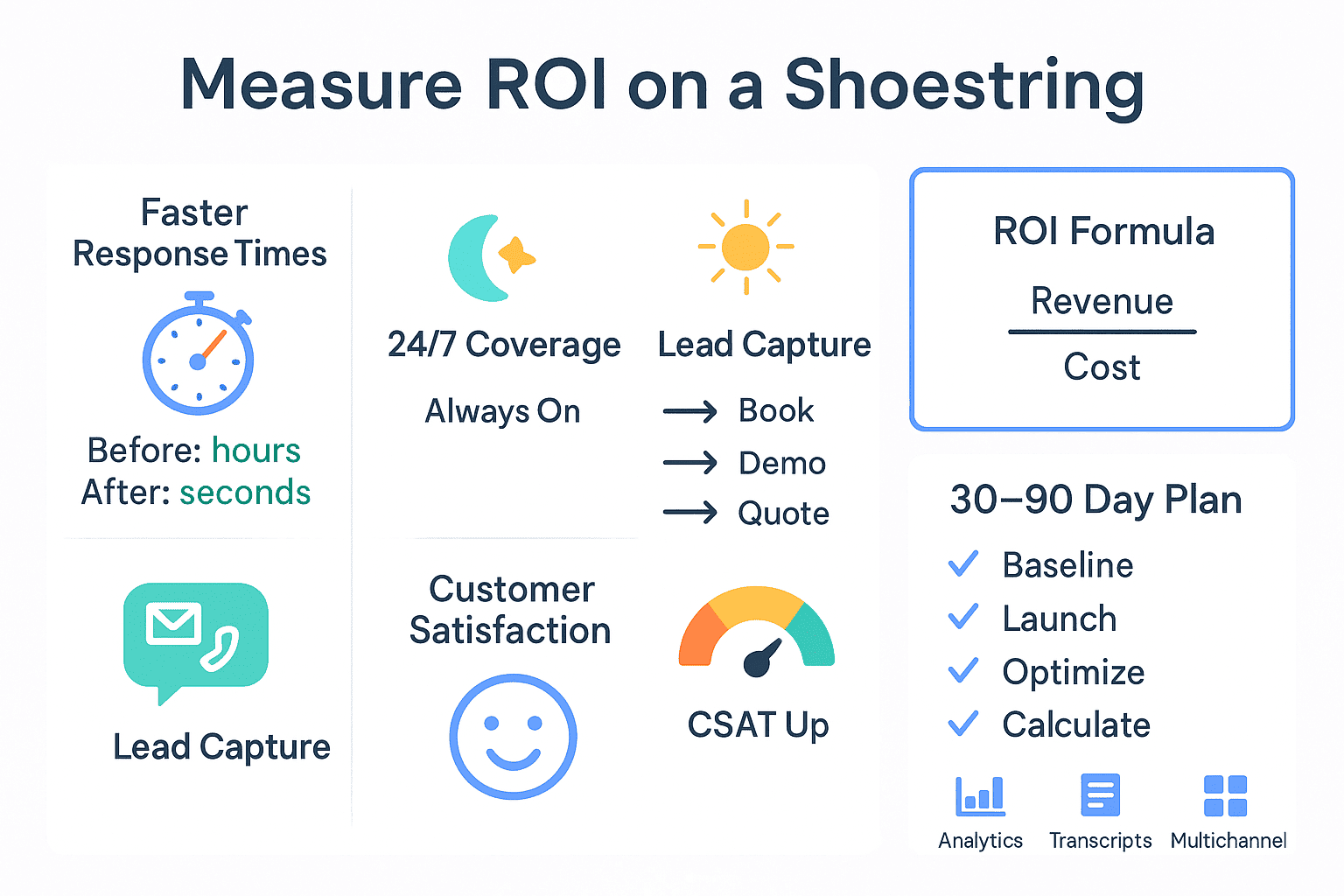
For early-stage brands, money is tight and time is even tighter. You need results you can measure, not vague promises you cannot track. When you deploy an AI chatbot with noem.ai, you can tie success to a few simple numbers that show real impact. These include faster response times for visitors, 24/7 support coverage, more leads captured from website conversations, and clear customer satisfaction signals. Each item maps to either more revenue or lower costs, so you can calculate ROI without a huge analytics project or a complex tech stack.

A lean measurement plan can be set up in a single afternoon and tuned over the next few weeks. You take a baseline, turn the bot on, and watch what changes. You focus on leads, response time, and customer happiness because they move the needle most. Then you add cost savings from fewer basic questions that need a human to answer. This simple plan mirrors how founders test growth levers and decide what to scale next (ref: noem.ai ).

Early-stage teams also need trust and speed from their tools. noem.ai brings builder, hosting, knowledge sync, multichannel publishing, and analytics into one place, so you ship in minutes, not weeks. When the system auto-syncs your new content, answers stay current without manual re-training, which keeps your results steady over time. That matters when your site is changing often or your product is evolving. It also matters when you have a small staff and cannot babysit your tools all day (ref: noem.ai ).

The Simple ROI Formula Founders Can Run in a Spreadsheet

A plain, trusted formula works best when you are short on time. Most teams track ROI as a percent using a simple math setup: ROI% = (Annual Benefits − Total Investment) / Total Investment × 100. To make this useful, define what “benefits” mean for your brand. For most early-stage companies, benefits come from more revenue and lower costs. Keep your inputs tight and easy to collect so you do not stall out or guess.

  • Increase in revenue: Capture more leads from website conversations, convert more of those leads, or raise average order value if your bot nudges better choices. Even a few extra deals a month can pay for the tool. With strong chat experiences, brands often see faster paths to purchase, because questions are answered right away and the shopper stays in the flow (ref: noem.ai ). As you gather data, you can attribute a portion of revenue to the conversations that started in chat.
  • Decrease in costs: Deflect simple, repetitive questions to the bot and you reduce the volume and minutes your human team spends on those issues. When you are small, even hour-by-hour savings add up over a month. This is a clear win during nights and weekends, when coverage is hard and can be expensive. Evidence from real AI deployments shows strong payback timelines when containment improves and manual handling drops (ref: Technova Partners ).
  • Keep the inputs honest: Do a quick 30-day baseline before you launch the bot. Then compare post-launch to the same mix of days and traffic. Use a simple sheet to record leads, close rate, revenue per customer, and support hours saved. You can reach a confident ROI estimate without a big analytics build (ref: MakoLab ).

Longer term, the compounding benefit is that you keep improving. The more your team learns from the complete conversation history, the more you can refine your flows. That lifts both conversion and satisfaction. That is why a small set of metrics can tell a big story when tracked week by week (ref: noem.ai ).

The Four Metrics That Matter: Speed, Coverage, Leads, and Happiness

  • Faster Response Times for Visitors: Speed wins attention and trust, especially for paid traffic and high-intent pages. An AI chatbot on your site responds right away, so visitors do not bounce while waiting for an email reply. Quick answers keep the shopper or prospect engaged in the moment, which supports better conversion later in the journey. Industry experience shows that faster replies shorten sales cycles and reduce drop-off at key steps, making the impact both visible and valuable (ref: noem.ai ).
  • 24/7 Customer Support Availability: Cover your nights, weekends, and holidays without hiring more staff. When customers get help at any hour, they are less likely to churn or leave a bad review. The bot can handle FAQs, policies, and product info, and then surface the right call-to-action like a booking or a quote request. Real deployments show strong return windows when you keep service “always on” and let your human team focus on harder work during business hours (ref: Technova Partners ).
  • Lead Capture from Website Conversations: Conversation is great, but contacts are gold. With noem.ai, you can design prompts that collect email, phone, or booking info in a friendly way. You can nudge visitors toward “book a consult,” “request a quote,” or “get a demo,” based on intent signals and your catalog or calendar. Sales research shows AI in sales can lift lead volume and lower costs, making chat a direct path to more pipeline (ref: Cirrus Insight ).
  • Complete Conversation History: When you see every chat in one place, patterns pop out fast. You can spot confusing policies, broken pages, and missing product details, then fix them and watch the questions drop. You can also track sentiment to see how people feel during the chat, and tweak replies or flows to make them clearer. This turns support into a feedback loop that feeds product, marketing, and service improvements week after week (ref: noem.ai ).

These four areas match the focus of noem.ai as an integrated, no-code platform. You build, host, sync, and publish in one dashboard, and you get analytics that map straight to real outcomes. You can roll out to your website, WhatsApp, or other channels without extra tools to glue things together. For a small team, that means less overhead and faster iteration cycles in the first 90 days (ref: noem.ai ).

How Real Teams Turn Chat Into Measurable Wins

Start with a tight scope and a short list of goals. This helps you avoid overbuilding and keeps your team aligned on the numbers that matter. First, decide which pages or campaigns will get chat, like your pricing page, key product pages, or a high-intent blog post. Next, write short, friendly prompts that guide people to action, like “Want a quote?” or “Have a quick question?” Then wire your bot to log leads into your CRM or email tool so you do not lose any data.

  • Use a 30-day baseline to build trust in the numbers: Track website leads per week, the percent of leads that close, and average revenue per customer. Track average first-response time before chat and after chat. Also note support volume and the average time it takes a human to handle simple FAQs. Comparing pre and post is the best way to show value to your team and any investors watching your funnel (ref: MakoLab ).
  • Let 24/7 coverage do the heavy lifting: Many early teams miss calls and messages outside work hours. A chatbot meets visitors at any hour and gives clear next steps. For service businesses, this turns into more bookings and fewer missed opportunities in just a few weeks. In fact, local service brands using noem.ai are advised to measure results over 30–90 days to see booking lift and fewer missed messages, which is a very practical way to show ROI (ref: noem.ai ).
  • Tie lead capture to real revenue: Do not stop at counting emails. Watch how many chatbot leads become qualified, how many demos or bookings close, and what your average revenue per deal looks like. Sales studies show AI-driven interactions can increase leads and compress time-to-value, which boosts revenue without growing headcount (ref: Cirrus Insight ). When these leads close, you have a direct revenue line that you can attribute back to chat.
  • Track customer happiness the simple way: Use a one-tap CSAT question at the end of the chat. Pair that with sentiment analytics to see if people sound frustrated or pleased along the way. Small gains in CSAT can reduce churn and increase reviews, repeats, and referrals. noem.ai highlights how sentiment-aware flows lift helpfulness and clarity, which you can see in your transcripts and scores over time (ref: noem.ai ).

Finally, keep your process lean and repeatable. Each week, review the top 10 questions asked in chat. Update your FAQ, product pages, or scripts to make answers shorter and clearer. Publish changes with one click so your bot reflects new content right away. Then check next week’s numbers to see if the top questions shifted or dropped (ref: noem.ai ).

A 30–90 Day Plan You Can Run Without a Data Team

  • Days 0–7: Baseline and Setup: Before you launch the chatbot, record your current numbers. Track average first-response time, website leads per week, close rate, support tickets per week, and average handle time per ticket. Note any peak hours when you miss calls or chats. Install the noem.ai widget on your most important pages and connect your knowledge sources and CTAs. The setup is no-code and includes analytics, which helps you get moving fast without more tools (ref: noem.ai ).
  • Days 8–30: Launch and Learn: Let the bot handle first-contact questions right away, so visitors do not wait and bounce. Keep prompts simple and friendly, with clear CTAs like “Book a consult” or “Get a quote.” Start measuring conversations started, leads captured via chat, response time, and the share of chats that resolve without a human. If your brand serves local customers, track how many bookings now come from late nights and weekends, when you used to be offline (ref: noem.ai ).
  • Days 31–60: Optimize for Outcomes: Study conversation history to find the top topics and the places where users get stuck. Improve answers, shorten steps, and add missing content or links. Use sentiment insights to make replies warmer, clearer, and more direct, which can boost CSAT and reduce back-and-forth. Add context-aware CTAs to move users to purchase, booking, or demos at the right time (ref: noem.ai ).
  • Days 61–90: Measure ROI and Decide Next Steps: Now that you have a month or two of data, calculate incremental revenue: chatbot leads × close rate × average revenue per customer. Add cost savings from less manual handling: deflected conversations × agent time saved × hourly cost. Compare your annualized benefits to total investment to get ROI%. If the numbers look strong, expand to more pages or channels from the same noem.ai dashboard (ref: MakoLab ).

When teams follow this plan, they get a fair read on performance in a short time frame. The key is to keep your measures simple and your changes small but steady. That way, you see cause and effect clearly. You also build a record of wins you can share with leaders, partners, or investors. Over time, this steady improvement curve supports better revenue forecasting and stronger unit economics (ref: Technova Partners ).

What the Data Says About ROI (and Why It Builds Over Time)

Independent reviews of AI deployments report fast payback and strong ROI when teams measure the right things. In several audited cases, brands tracked response times, self-serve resolution, and satisfaction gains, then linked those shifts to clear cost and revenue outcomes. Because setup costs are front-loaded, year-two ROI can look even better as you keep improving answers and flows. This compounding comes from learning what people ask and making those answers easy to find and act on. Better service also leads to better reviews and word of mouth, which support long-term growth (ref: Technova Partners ).

  • Clear benefits from speed and availability: Faster first replies and 24/7 coverage reduce drop-off and wasted clicks, especially for high-intent traffic. Better service at odd hours captures value that used to slip away. As you deflect routine questions, your team spends time on deeper, higher-value conversations. That shift often shows up in both revenue per rep and lower support costs (ref: noem.ai ).
  • Sales impact from guided conversations: When your bot connects answers to timely CTAs, you reduce friction on the path to purchase or booking. This is why AI in sales is linked with higher lead volume and lower process costs. For small teams, more qualified leads per week can swing monthly revenue by a meaningful amount. Put that into your sheet, and you will see how a few wins per month cover the subscription easily (ref: Cirrus Insight ).
  • CSAT as a growth signal, not just a score: Sentiment and CSAT help you see what to fix first and how to coach your bot’s tone. Improving clarity and empathy can lift satisfaction and cut repeat contacts on the same issue. Over time, happier customers come back more and refer more. That is real money that flows into your ROI math, even if you start with conservative assumptions (ref: noem.ai ).

This is where the integrated approach of noem.ai pays off for early-stage brands. You design, deploy, and measure in one place, and knowledge auto-sync keeps answers fresh without extra work. Real-time analytics, missed-question alerts, and one-click updates close the loop fast. You do not need separate tools for building, hosting, publishing, and analysis, which simplifies your stack and reduces total cost of ownership (ref: noem.ai ).

What To Track in Your Dashboard (And Why It Proves ROI)

  • First-Response Time (Pre vs. Post): This shows how much faster visitors get help once chat is live. When replies are instant, people are more likely to stay, ask more questions, and convert at a higher rate. Track this by page and campaign, so you see where speed matters most. Faster answers also mean fewer emails and voicemails to return later, which saves your team time (ref: noem.ai ).
  • Containment Rate (Fully Bot-Resolved): This reflects how many chats the bot handles end-to-end. As this number rises, your team handles fewer basic questions and can focus on complex tasks. In real-world evaluations, higher containment supports faster payback and stronger ROI because you remove cost from common workflows. This is a simple number with a big impact (ref: Technova Partners ).
  • Leads Captured (and Quality): Count emails, phone numbers, quotes requested, demos booked, and carts recovered that started in chat. Then track how many of those convert and the average revenue per closed deal. This is the most direct tie to top-line growth. Studies on AI in sales show that this kind of automation and guidance can increase leads and reduce cost to serve new prospects (ref: Cirrus Insight ).
  • CSAT and Sentiment Trend: Ask a quick rating at the end of chat and track changes over time. Pair the score with sentiment from the transcript to see where the tone or clarity needs work. Small tweaks to wording can yield meaningful lifts in CSAT. A sustained CSAT increase can lower churn and raise lifetime value, which you can model in your ROI sheet (ref: noem.ai ).

Your dashboard should make these metrics easy to read and share. noem.ai focuses on real-time analytics and missed-question alerts so you can improve quickly and see the results in weeks, not quarters. This is the kind of speed early-stage brands need. It keeps your efforts lean and your wins visible (ref: noem.ai ).

Putting It All Together: A Founder’s Checklist for the Next 30 Days

  • Pick the channel and pages that matter most: Start with your homepage, pricing, or a high-intent product page. Add the noem.ai widget and connect your knowledge sources. Write 3–5 prompts tied to actions like booking, demo, or quote request. Keep the tone simple and helpful so people do not feel pushed (ref: noem.ai ).
  • Baseline and goals: Record your current numbers and set a first target, like “Capture 30% more website leads in 30 days,” or “Raise CSAT by 5 points,” or “Cut average first-response time to under 1 minute.” Keep it realistic and tied to your funnel math. This keeps your team focused and makes the before/after story easy to share. You can adjust targets after you see the first two weeks of data (ref: MakoLab ).
  • Daily review in week one: Each day, scan conversations for missed questions or unclear answers. Fix wording and add links or snippets to make answers crisp. Watch for repeat topics and address them in your product pages or FAQs. Small changes made quickly will show up in your numbers by week two (ref: noem.ai ).
  • Weekly share-out: Summarize your key metrics for your team and any stakeholders. Highlight wins like nights-and-weekends leads or a drop in time to first response. Note one or two fixes you will make next. This habit builds confidence and keeps your momentum strong (ref: Technova Partners ).

By following these steps, you build a sustainable system that proves value and guides smart investment. The work is simple, repeatable, and focused on the few metrics that matter. You do not need new headcount or a big consulting spend to get going. You just need tight goals, the right tool, and a steady rhythm of review and improvement. That is how early-stage brands win on a shoestring.

Ready to see faster replies, 24/7 coverage, more captured leads, and happier customers—without adding headcount? Try the no-code chatbot from noem.ai, publish in minutes, and track the impact in one dashboard. Want help choosing the first flows to launch? Book a quick consult and we will share a simple 90-day plan. Prefer to start small? Turn on the widget on a single page and measure results for the next 30 days. What is the one page on your site that would earn back the cost fastest if chat captured just a few more qualified leads this month?

Focus on Decisions, We’ll Handle the Rest

While you make strategic decisions, Let Agent Noems efficiently run your company’s departments:

  • AI Support Chatbots
  • Lead Conversion Chatbots
  • Coaching Chatbots
  • Onboarding Chatbots
  • Virtual Clone Chatbots
Try It for Free

Where should we send your invitation to?