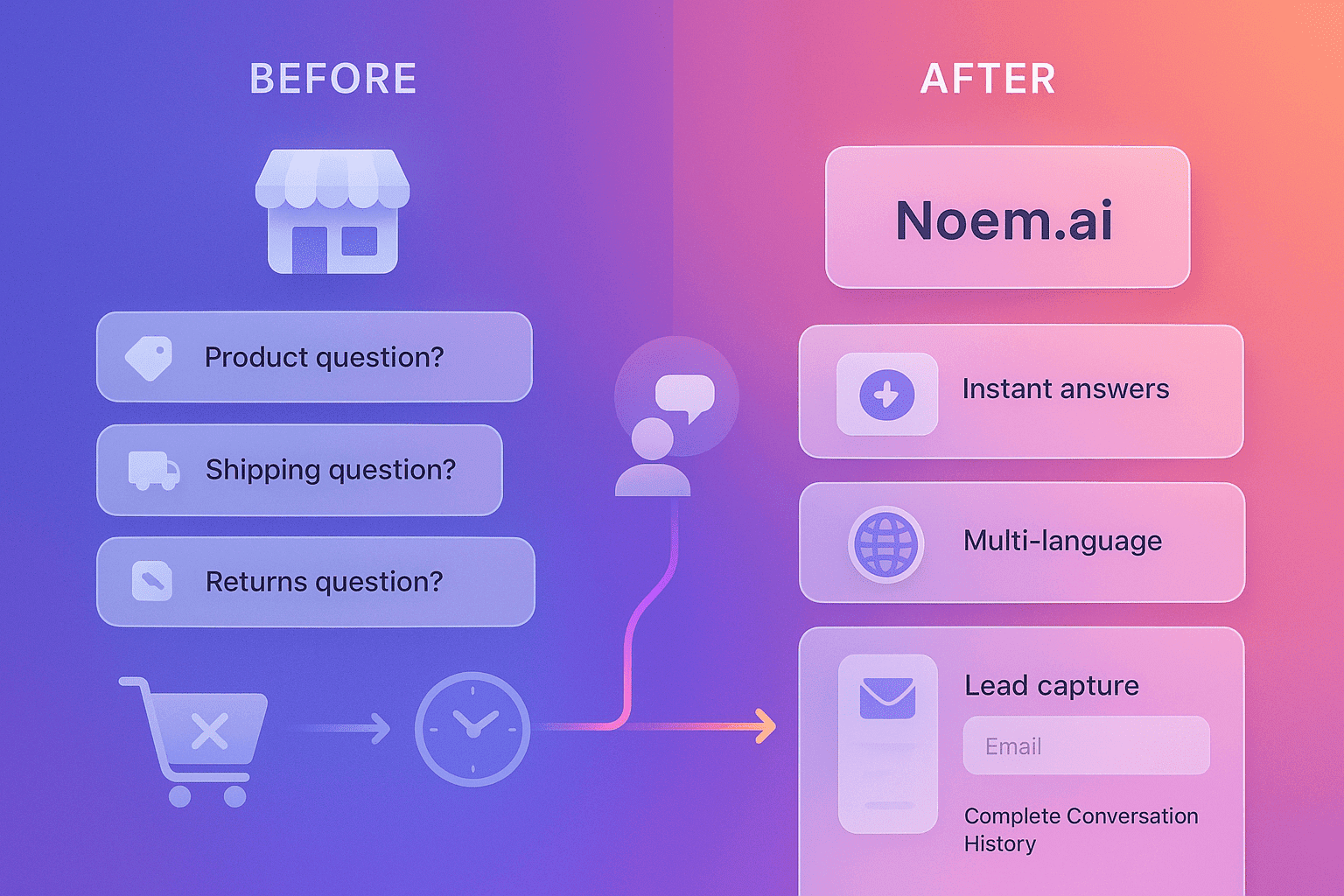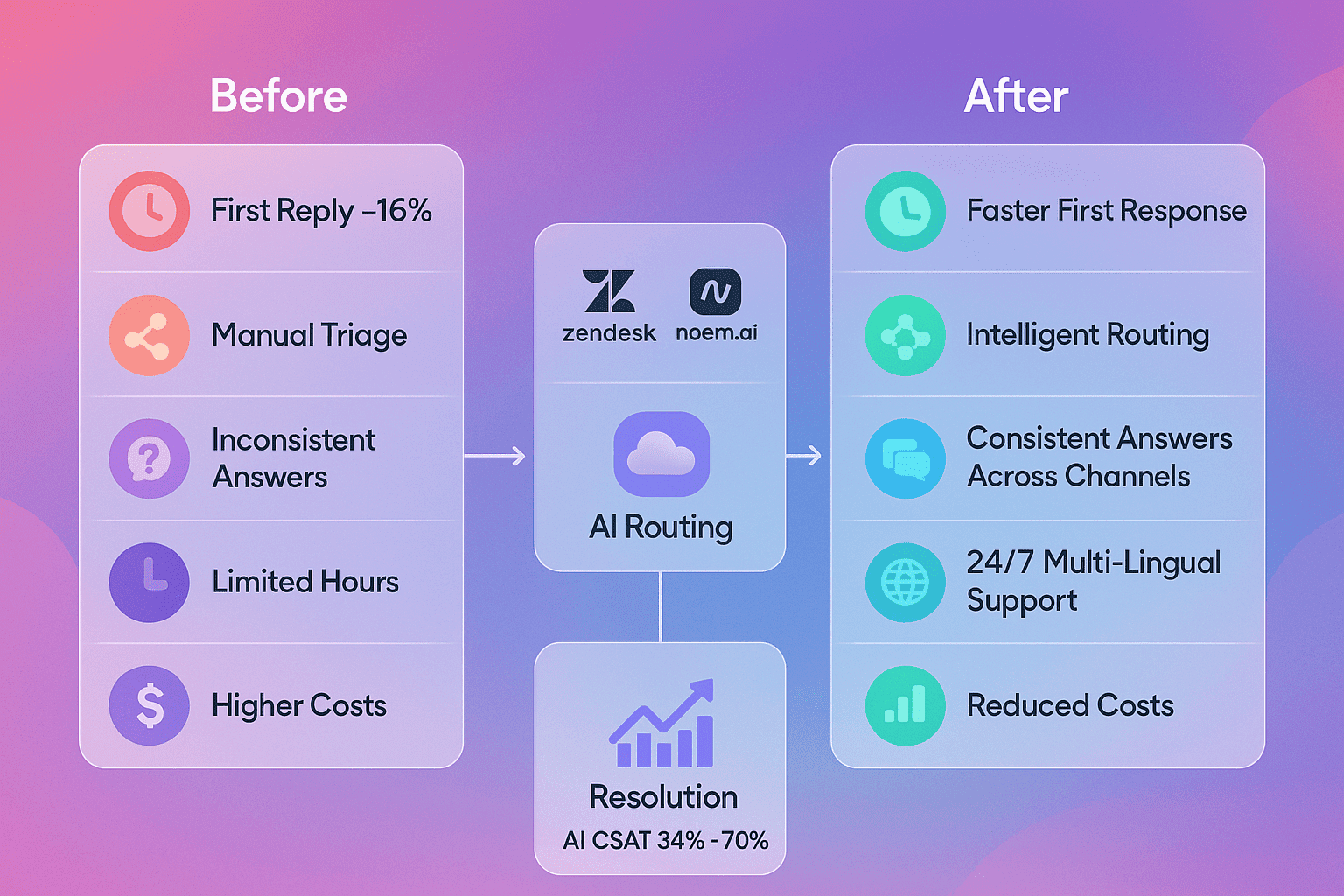
A new year brings new customer expectations. Shoppers and clients want fast answers, in any language, on any channel, day or night. They also expect those answers to be the same everywhere they ask. AI-first support tools are built to deliver this. They give teams real-time insights, full conversation history, and predictable costs (ref: Crescendo.ai ).
If you run a business, this is your edge. AI tools now cut response times by up to 80% and lower support costs by 30–50%, while still handing tough issues to trained agents. This balance helps you scale without adding stress or chaos (ref: Crescendo.ai )(ref: Suptask ). With the right platform, your customers get consistent answers across web chat, email, SMS, and social. Your team also gets better data on what customers need and why they ask (ref: eDesk ). And when you’re ready to move fast without heavy setup, tools like noem.ai make it easy to design, deploy, and improve a helpful bot in minutes.
The fast lane to happy customers and lower costs
Key Points
- Consistent Answers Across Channels
- 24/7 Customer Support Availability
- Multi-Lingual Customer Support
- Reduced Support Costs
- Complete Conversation History
- Actionable Customer Insights
Why AI-First Support Tools Beat Old Playbooks
AI-first tools don’t just “add a chatbot.” They bring a full stack: knowledge syncing, multi-channel publishing, analytics, and quick training. This means your answers stay consistent across channels because the same source powers web chat, WhatsApp, SMS, Facebook Messenger, and email. It also means your team can launch faster and keep content fresh without heavy manual updates (ref: eDesk ). Platforms like noem.ai focus on speed and trust, so small teams can go live in minutes and still feel confident that answers are correct.
- Consistent answers across channels: Customers expect the same message everywhere. AI-first platforms centralize knowledge, so updates flow to every channel at once. This stops the drift that happens when email says one thing but chat says another. Teams gain trust because the system enforces one source of truth (ref: eDesk ).
- 24/7 availability, without burnout: AI can handle common questions at any hour, then escalate when needed. This makes your brand “always on,” even if your team sleeps. Studies show AI can cut response times by up to 80% by solving repetitive tasks on its own. That speed wins customers when they need help right away (ref: Crescendo.ai ).
- Multi-lingual support that scales: Global buyers want answers in their language. AI-first tools reach 50+ languages with high accuracy and quick translation. This helps you serve new markets without staffing every time zone. It also respects cultural nuance, which makes customers feel heard (ref: Crescendo.ai ).
- Full conversation history across channels: When support knows the whole story, it solves faster and smarter. AI tools pull context from chat, email, and social into one view. That record helps with training, quality checks, and audits. It also powers better handoffs from bot to human (ref: Usersnap ).
- Actionable insights that drive decisions: Modern platforms turn messages into data. You can see top topics, sentiment, and gaps in your knowledge base. These insights help you ship better policies and fix confusing steps on your site. Over time, this lifts retention and reduces repeat tickets (ref: Pylon ).
- Predictable cost control: AI handles routine work so agents focus on complex cases. Many teams see 30–50% lower support costs by routing simple questions to automation, then logging and measuring what remains. This gives finance teams clean numbers and leaders a clear path to scale. It also keeps quality high as volume grows (ref: Suptask ).
Across industries, customers also expect seamless multi-channel experiences. In fact, 86% of consumers want consistent communication across channels, which is easier to deliver when your inbox and chat are unified and powered by AI (ref: eDesk ). This is why platforms like noem.ai focus on multi-channel publishing and real-time analytics in one place. By syncing your knowledge base and deploying to web, SMS, WhatsApp, and more, noem.ai helps you deliver the same answer everywhere. That builds trust with customers and reduces time spent on manual updates.
The Top 10 Customer Support Tools for 2026 (What Each Does Best)
Below is a curated list of leading tools. Each one stands out for different reasons, from automation depth to eCommerce fit and enterprise workflows. Your choice should match your stack, your channels, and your team size. Use these notes to pick the right shortlist for your pilot.
- Crescendo.ai — enterprise-grade automation across all channels: Crescendo focuses on large-scale automation with strong language support. Reports highlight accuracy across 50+ languages and full-time coverage across chat, voice, email, and SMS. This approach helps global teams keep answers consistent and fast everywhere. It also supports cost control with automation-first routing (ref: Crescendo.ai ).
- Gorgias — eCommerce powerhouse for Shopify and Magento: Gorgias brings order data into the support view for quick refunds, exchanges, and order checks. It shines for high-volume stores where many tickets are order-related. Teams can deflect simple questions and speed up complex ones with templates and rules. This mix helps stores recover lost revenue with faster help (ref: Suptask )(ref: eDesk ).
- Zendesk — proven multi-channel ticketing with AI assist: Zendesk blends ticketing, knowledge, and analytics in one platform. Its AI tools help deflect common questions and guide agents with suggestions. The unified inbox helps meet multi-channel expectations across web, email, and social. For many enterprises, this balance offers scale and control (ref: Suptask )(ref: eDesk ).
- Zoho Desk — orchestration inside the Zoho ecosystem: Zoho Desk fits well when your company already runs on Zoho apps. It uses automation rules to reduce manual work across channels and teams. Strong dashboards show trends in topics and response health. This helps leaders find the best areas to improve (ref: Crescendo.ai ).
- eDesk — all-in-one for US eCommerce marketplaces: eDesk consolidates marketplaces, social, email, and chat into one inbox. This gives stores a clean view of every message from every channel. Teams answer faster because context is right there in the thread. Customers get a smooth experience no matter where they ask (ref: eDesk ).
- LiveAgent — universal inbox with strong voice features: LiveAgent offers phone, IVR, and even video support along with chat and email. For teams that need telephony plus digital channels, it can be a good fit. Automation rules help deliver round-the-clock support without overloading agents. Call recording and distribution add control in busy call centers (ref: eDesk ).
- Pylon — B2B support and success insights in one place: Pylon brings Slack, Teams, and email into one system to help B2B companies track customer health. It can flag feature requests, risks, and trends in conversations. This helps success and support teams act before small issues become churn. Leaders get a clear view of account health (ref: Pylon ).
- Intercom (Fin AI) — outcomes focus for modern support teams: Intercom pairs chat-first tools with pricing that aligns to outcomes. It can run multi-step resolutions and route harder cases to the right person. Businesses like the speed of setup and the quality of the messenger experience. The result is faster help on your site and in your app (ref: Suptask ).
- ServiceNow (Now Assist) — deep workflows for larger orgs: ServiceNow connects support with back-office processes like HR and IT. It helps big teams enforce safe policies while still using AI to recommend next steps. The system’s strength is governance and integrations with enterprise data. This makes audits and approvals easier at scale (ref: Suptask ).
- Ada — quick FAQ deflection for growing teams: Ada is known for fast setup and clean experiences for common questions. It works well when you want a dependable deflection layer with clear bundles. As you grow, you can expand channels and languages with fewer hurdles. For many SMBs, this is a simple win (ref: Crescendo.ai ).
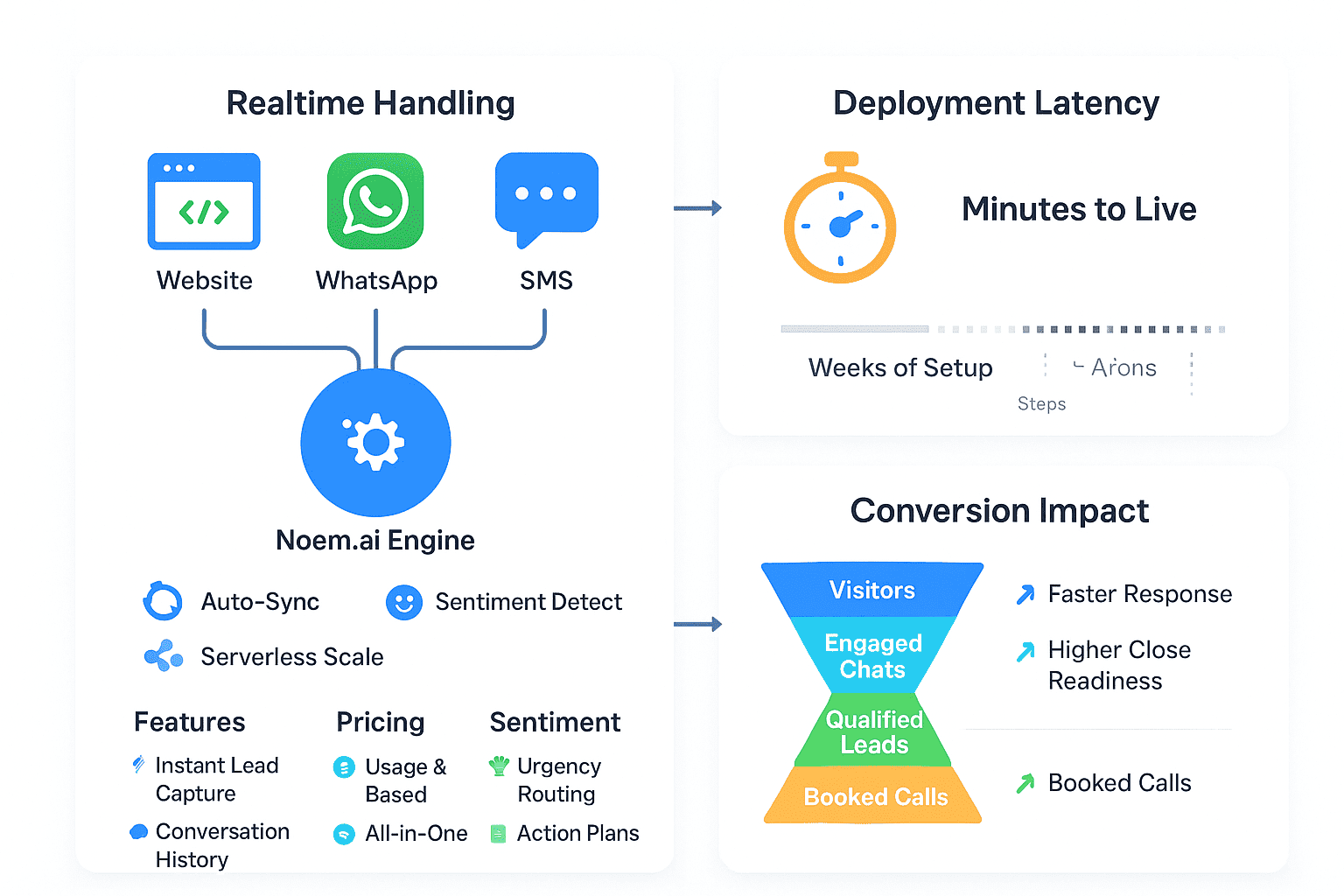
One more option to consider is noem.ai, an AI Concierge platform built for speed and accuracy. You pick a role, sync your knowledge base from files, URLs, or apps, and deploy across your website, SMS, WhatsApp, voice, Slack, and social — no code required. Because answers are grounded in your own content via retrieval-augmented generation (RAG), you get accuracy from day one, plus weekly sentiment and intelligence reports that show what customers are actually asking. If you want fast time-to-value, noem.ai is designed so small teams can go live in minutes instead of weeks.
Proof Points That Matter to Business Owners (With Sources)
When picking a tool, cut through the noise and look at the numbers. Businesses that adopt AI for routine questions see up to 80% faster responses. They also report 30–50% lower support costs once the bot handles simple tasks and hands off deeper issues to humans (ref: Crescendo.ai )(ref: Suptask ). These savings are not just “nice to have.” They make room for better training and better customer care.
- Consistency across channels boosts trust: 86% of consumers expect a seamless, multi-channel experience. If your answers change from chat to email, trust drops and tickets repeat. A unified inbox with synced knowledge solves this. It also makes reporting clearer and fixes faster (ref: eDesk ).
- Language and accuracy unlock growth: AI platforms now report high accuracy across 50+ languages. This helps you reach new customers without hiring native speakers in every market. Better translation plus tone control leads to fewer misunderstandings. Your brand sounds like itself across borders (ref: Crescendo.ai ).
- Analytics turn support into a growth channel: When every conversation is captured, you can see patterns fast. Product teams learn which steps confuse people most. Marketing learns which messages work best. Leaders can plan improvements with confidence (ref: Pylon ).
- Time-to-value is a real advantage: The faster you go live, the quicker you learn and improve. With no-code tools and guided setup, teams can launch bots quickly and then iterate. This saves weeks compared to heavy custom builds. Platforms like noem.ai are designed to help small teams deploy, test, and improve in a single dashboard.
- Cost control matters as you scale: Savings from automation show up as lower handle time and fewer tickets per order or user. These savings compound when volume spikes. Clear analytics show what the bot handles well and what to train next. Finance teams get predictable, usage-based costs they can model (ref: Suptask ).
To make this real, think about your current ticket mix. If 60–70% of tickets are simple “where is my order?” or “how do I log in?” type questions, those are perfect for AI. The system can answer instantly, log the results, and learn from misses. Then your agents can spend more time on account-specific, high-value issues. This lifts satisfaction and protects your team from burnout (ref: Usersnap ).
A Simple Playbook: Launch AI-First Support in 30 Days
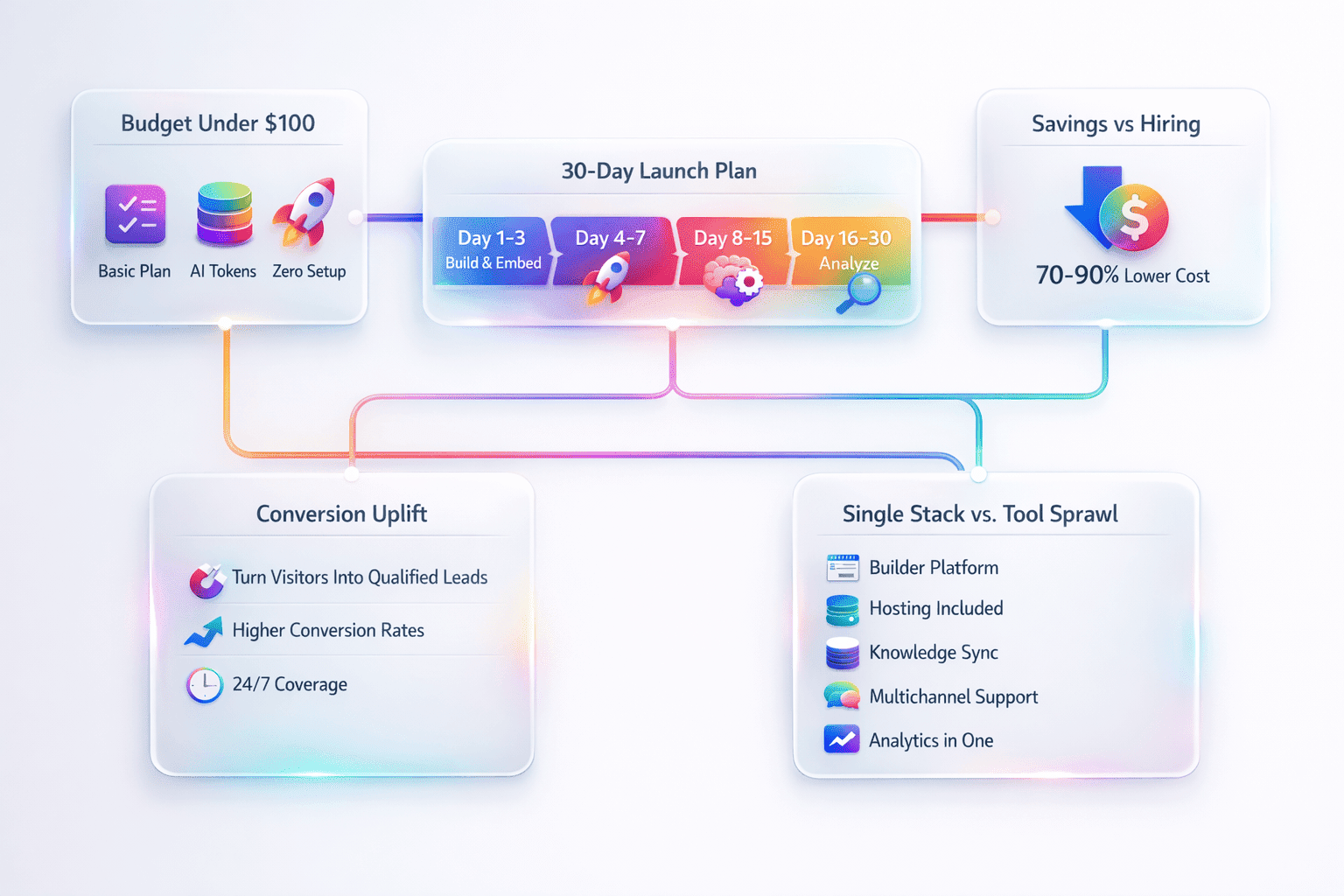
Moving to AI-first does not have to be complex. You can go live in one month with a clear plan. Keep it simple and focus on the biggest, repeatable wins. Use a no-code platform so your team can control the steps and measure results from day one.
- Week 1 — connect knowledge and pick channels: Gather your FAQs, help docs, shipping rules, and policy pages. Connect them to your platform and set live channels like web chat, WhatsApp, SMS, or Facebook Messenger. Make sure the bot uses the same source of truth across all channels. Tools like noem.ai make this easy with knowledge sync and multi-channel publishing in one place.
- Week 2 — design flows for top 10 intents: Look at your last 90 days of tickets to find the most common questions. Design short flows or scripted steps for these so the bot can resolve fast. Keep the language clear and friendly. Test on a small page or a low-traffic time window.
- Week 3 — enable handoffs and conversation history: Set rules for when to hand off to a person (like account lockouts or billing disputes). Make sure full conversation history flows to the agent so the customer never has to repeat themselves. This keeps CSAT high and saves time. Train your team on how to use the shared transcript for faster answers (ref: Usersnap ).
- Week 4 — measure, optimize, and retrain: Track deflection rate, response time, and customer satisfaction. Review missed questions and add answers or improve flows. Do weekly updates so the system learns fast. With one-click retraining in platforms like noem.ai, you can keep getting better without a heavy lift.
This four-week approach keeps you focused and reduces risk. You’ll see quick wins on simple tickets while building a durable base for more complex work. Over time, your team will trust the data and your leadership will see the ROI. Your customers will feel the difference in speed and clarity.
What Features Should You Demand?
As you compare tools, anchor your decision on the features that actually move the needle. Some tools look flashy but won’t help your team day to day. Others quietly nail the basics that save hours and make customers smile. Here is a simple checklist to guide your choice.
- Knowledge sync that never goes stale: Your system should auto-sync from files, URLs, and connected apps. This keeps every channel up to date with no manual copy-paste. Look for change logs and versioning to track updates over time. This feature helps avoid old answers that create repeat tickets (ref: eDesk ).
- Multi-channel publishing from one dashboard: You should design once and deploy everywhere—web, WhatsApp, SMS, Facebook Messenger, and email. This saves setup time and reduces errors. It also gives you one place to measure everything. Platforms like noem.ai make this multi-channel step simple.
- Complete conversation history for every handoff: Give agents the full story so they can act fast. Unified transcripts help teams avoid repeating questions and missing context. This supports better audits and training. It also smooths the customer journey (ref: Usersnap ).
- Real-time analytics and alerts: You should see top topics, sentiment, and trends quickly. Alerts for missed questions let you fix gaps fast. Over time, this builds a strong knowledge base and fewer escalations. Leaders get decision-ready data, not guesswork (ref: Pylon ).
- Multi-lingual coverage with quality controls: Choose tools that support 50+ languages with high accuracy, plus tone control. This keeps your brand voice steady across borders. It also protects quality as you scale. Ask vendors for examples and tests (ref: Crescendo.ai ).
- Usage-based pricing that scales: As your volume grows, your costs should scale in a predictable way. Pay for what you use and track cost per resolution. This helps finance plan growth without surprise bills. It also encourages smart automation of the right use cases (ref: Suptask ).
When a platform checks these boxes, your team can move faster, your answers stay consistent, and your costs remain under control. By picking a solution that bundles building, hosting, syncing, and analytics, you also cut vendor sprawl and integration pain. This is why an integrated stack like noem.ai fits many growing businesses that want speed and simplicity without giving up trust.
Real-World Scenarios: Where AI-First Makes an Immediate Impact
To see the value, it helps to picture real cases. These common scenarios show how AI-first tools deliver faster help and better outcomes right away. They also highlight why complete history and clear analytics matter. Each scenario is simple but powerful for busy teams.
- Post-purchase questions flood your inbox: After a big sale, customers ask about shipping, returns, and sizing. AI answers instantly with the latest policies and tracking steps, then only escalates edge cases. Now your agents focus on true exceptions rather than typing the same messages all day. Response times drop and customers feel cared for (ref: eDesk ).
- Multi-lingual burst from a global campaign: A campaign goes viral in new regions and tickets appear in many languages. AI resolves common requests in the customer’s language and shares full transcripts for agents who jump in. This protects quality even as volume spikes. Your team keeps pace without scrambling to find translators (ref: Crescendo.ai ).
- Account help across SMS, email, and web chat: Customers switch channels while solving a login or billing question. AI keeps one history so agents see every step, no matter the channel. The customer never repeats themselves, which prevents frustration. Leaders then analyze the flow and improve a confusing step (ref: Usersnap ).
- Product feedback hidden in support tickets: Many requests hint at product gaps. Analytics surface patterns in keywords and sentiment. Product and support then team up to fix the top issues first. This cycle boosts retention and lowers ticket counts (ref: Pylon ).
- Budget pressure during peak season: Your ticket volume spikes, but headcount cannot grow fast. Automation handles common questions, and clean handoffs keep service levels high. Cost per conversation stays steady because the bot takes the first pass. Finance can model outcomes with usage-based pricing (ref: Suptask ).
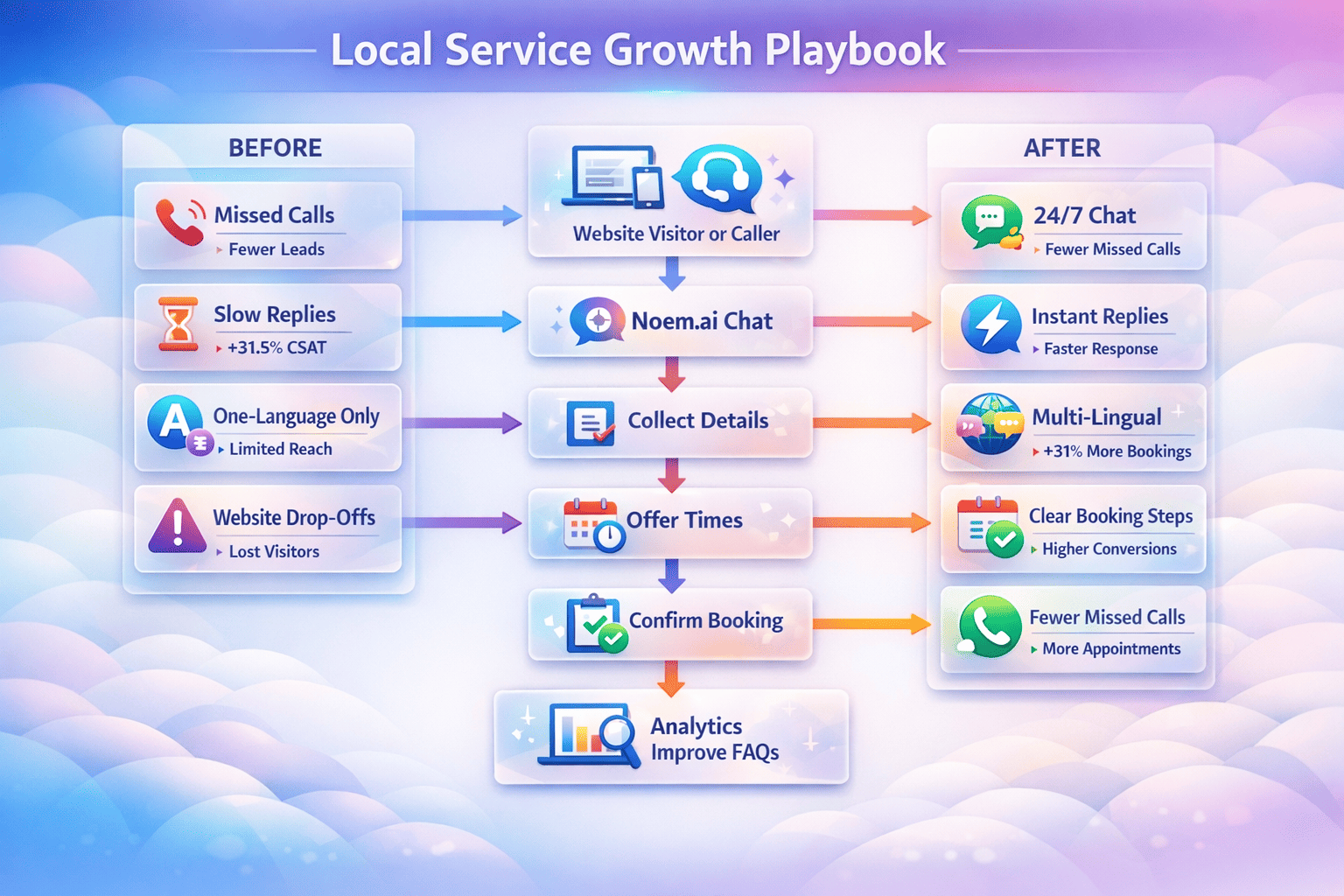
These situations repeat across industries—from retail and SaaS to local services. The pattern is the same: AI answers common questions fast, keeps history complete, and surfaces insights you can act on. Over time you reduce costs while lifting customer happiness. A tool like noem.ai makes this repeatable by bundling builder, hosting, sync, channels, and analytics in one stack.
How to Compare Shortlist Vendors
You can score each vendor with a simple 1–5 scale across six areas. This keeps you objective and helps your team agree. After a two-week pilot, fill in the scorecard with data, not guesses. Then pick the winner and scale.
- Setup speed and ease (1–5): How fast can you ingest knowledge and publish to 2–3 channels? Can a non-technical teammate handle most tasks? Are there guided templates that speed up flow design? This is a key sign of time-to-value.
- Consistency and governance (1–5): How do you keep answers aligned to the latest content? Does the tool show you what changed and when? Can you test safely before pushing live? Strong governance builds trust with your team.
- Omni-channel coverage (1–5): Which channels are one click to add? Can you match tone and formatting across each? Does the system keep one history across them? This determines how customers feel your brand.
- Accuracy and language (1–5): How does performance hold up across 50+ languages? Can you fine-tune style and guardrails? Are there alerts for low-confidence answers? This protects brand voice as you grow (ref: Crescendo.ai ).
- Analytics and insights (1–5): Can you see top topics and missed questions in real time? Do dashboards show trends that a manager can act on? Can you export or share with other teams? This turns support into a learning loop (ref: Pylon ).
- Cost and scalability (1–5): Is pricing usage-based and predictable? Do costs scale only when value scales? Can you model savings with deflection and response time? This protects margins as volume rises (ref: Suptask ).
By using a scorecard, you keep the process fair and focused. You can also share the results with finance and leadership for quick approvals. If you want a fast pilot across channels with minimal setup, invite noem.ai into your shortlist. Its single dashboard, knowledge sync, and real-time analytics make it a strong, simple choice for small teams with big goals.
Your Next Step
AI-first support tools aren’t just a trend. They are how modern companies deliver consistent answers across channels, 24/7 coverage, multi-lingual help, complete history, and insights you can act on. The hard data shows faster responses and lower costs, while the team experience gets calmer and more focused (ref: Crescendo.ai )(ref: eDesk ). If you want a quick, trusted path to launch, explore tools that bundle building, hosting, sync, channels, and analytics. That is the shortest road to value.
Ready to see it in action? Try a 30-day pilot with two or three vendors, including noem.ai, and measure response times, deflection, and CSAT. Your customers will tell you which one wins—often in the very first week.