
Your chatbot can talk to customers by text message (SMS) and phone call, not only in the website chat. This guide shows how to try your chatbot from your own phone in a minute, how to give it a real phone line with an AI Receptionist, and what replies look like on SMS and calls.
Where to find Phone and SMS #
- Open your project and click Deploy.
- Click Add (or Set up your first destination on a new chatbot).
- Choose Phone and SMS (“Answer calls and texts”).
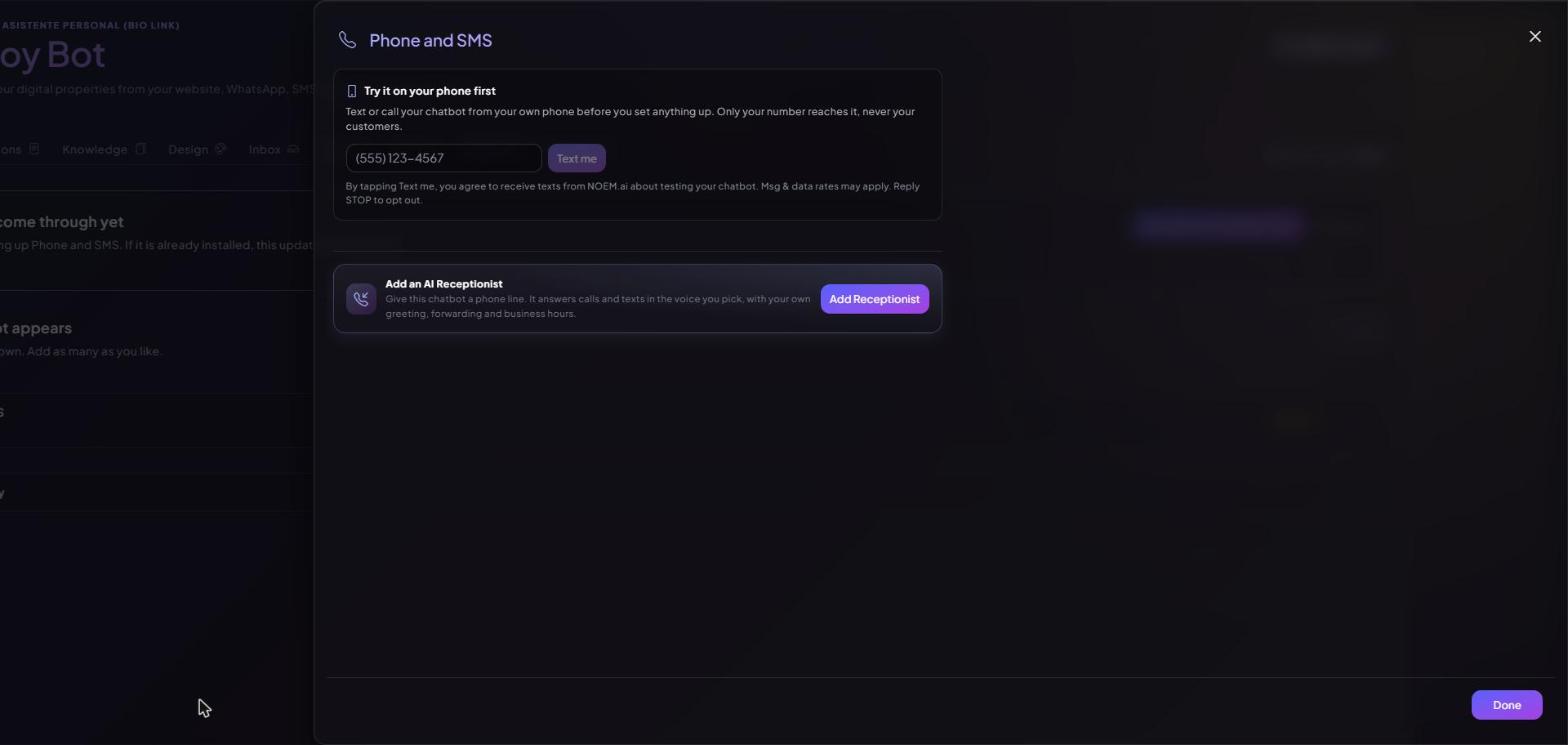
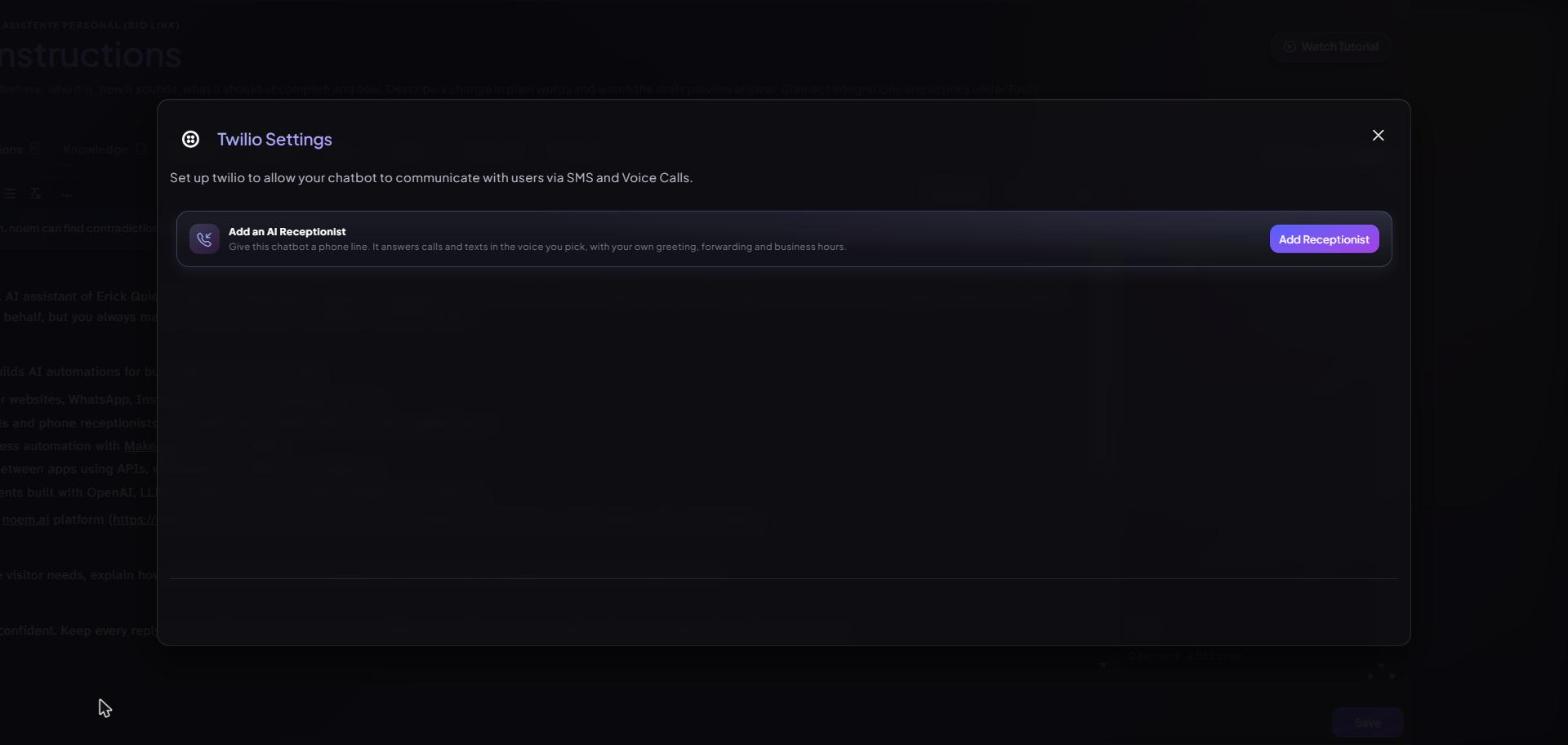
You will see two options: Try it on your phone first and Add an AI Receptionist. The Twilio option under Tools now leads to the same AI Receptionist setup.
Try it on your phone first #
Before you set anything up, you can text or call your chatbot from your own phone. Only your number reaches it, never your customers. This works on every plan.
- In the Phone and SMS dialog, enter your mobile number under Try it on your phone first.
- Click Text me. You will get a text from NOEM.ai.
- Reply to that text, or call, to talk with your chatbot.
- Your test chatbot answers from your draft, so you can try changes before you publish them. See Draft Mode and Live Mode.
- By tapping Text me, you agree to receive texts from NOEM.ai about testing your chatbot. Message and data rates may apply. Reply STOP to opt out.
- Testing is capped per phone number and per user, so it is meant for trying your chatbot, not for real customer traffic.
Give your chatbot a phone line: AI Receptionist #
When you are ready for customers to call or text a real number, click Add Receptionist. An AI Receptionist gives this chatbot a phone line. It answers calls and texts in the voice you pick, with your own greeting, forwarding and business hours, and it shares your chatbot’s knowledge so callers get the same answers as your website visitors.
For the full setup (voice, line language, call instructions, business hours and forwarding), see AI Receptionist: Your Phone Line and Chatbot Now Share One Brain.
What replies look like on SMS and calls #
- SMS replies are short. On text messages, every chatbot keeps replies under about 300 characters and asks at most one question per message.
- Plain text only. Cards, buttons and images from the web chat are turned into plain text. For example, a map card becomes the address and a Google Maps link.
- Your welcome message is sent as plain text on SMS and calls, even if you picked a style for the web chat.
Want different rules on the phone? Your chatbot knows which channel it is answering on. Open Channel and mode reference in the Instructions editor’s More menu and copy a ready-made SMS or phone rule. See Channel & Delivery: How to Write Instructions That Adapt by Platform.
Already using your own Twilio account? #
Some chatbots were connected to the owner’s own Twilio account before AI Receptionist existed, using an Account SID, Auth Token and webhooks. If that is your setup, the notes below describe how it works. For new phone lines, we recommend an AI Receptionist instead.
What the classic Twilio setup used #
- A Twilio account with a phone number that supports SMS and/or Voice.
- Your Account SID and Auth Token, from the Twilio Console under Account Info. Treat the Auth Token like a password.
- 10DLC registration for US business texting (A2P compliance).
- A forwarding number in E.164 format (for example +15551234567) for calls that need a person.
Inbound calls and texts with webhooks #
In the classic setup, your Twilio number sends incoming calls and texts to NOEM through two webhook URLs, one for voice and one for messaging. In the Twilio Console, open Phone Numbers, Active Numbers, select your number and open Configure. Under “A call comes in” and “A message comes in”, choose Webhook, paste the matching URL from NOEM and set the method to POST. Each chatbot has its own webhook URLs.
Troubleshooting #
- I did not get the test text. Check the number, including the country code, and that you have not replied STOP before. Testing is capped, so you may have reached the limit for that number.
- The chatbot answers with old information. The phone test uses your draft. Make sure your changes are saved. Knowledge changes go live right away.
- SMS replies feel too short. That is expected on text messages. Put longer details in a link the chatbot can share, or move them to a knowledge file.
- Classic Twilio setup is not receiving messages. Check both webhook URLs, the POST method, and Twilio’s logs under Monitor, Logs.
Best practices #
- Try your chatbot on your own phone after every important change, before you publish.
- Get consent before texting customers, and follow carrier and A2P rules.
- Keep phone rules short and clear, for example “On SMS, share one link at most”.
- Review phone and SMS conversations in your Inbox to spot answers that need work.


